Florus Relief ad: I Was Diagnosed With Ménière's At 51. I'm 62 Now. Turns Out The Ringing And The Vertigo Were Never My Inner Ear.

Florus Relief
133 active ads🇭🇰
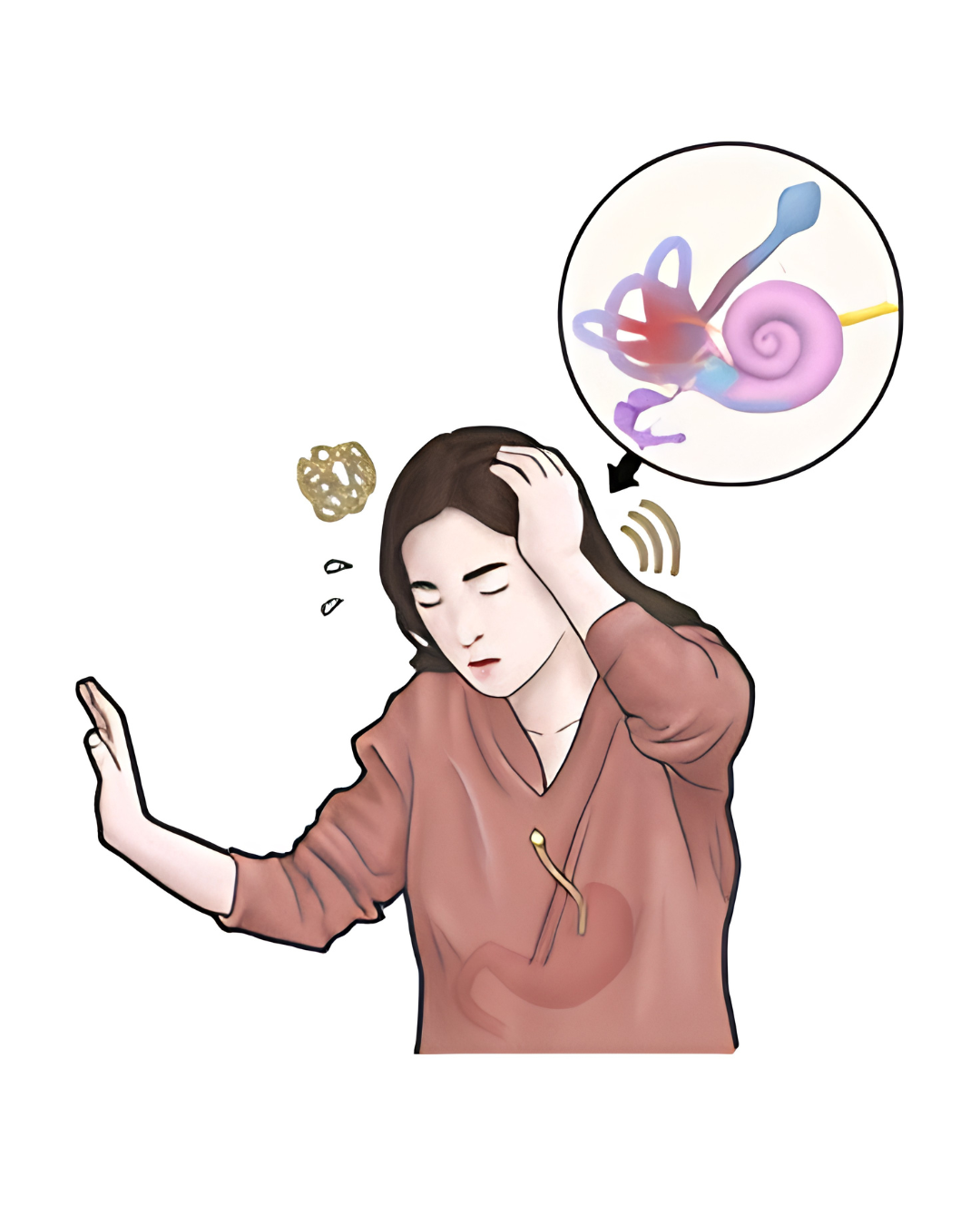
I was diagnosed with Ménière's disease at 51. I'm 62 now. Turns out I never had Ménière's at all. Or BPPV. Or labyrinthitis. Or any of the four ear-labels three different ENTs put on my chart over the last eleven years. I had something nobody screened me for, hiding in plain sight in the three or four "pressure days" I had every month. For eleven years, I "managed" a condition I didn't actually have. Eleven years of a low-salt diet so strict I stopped eating anything I did not prepare in my own kitchen. I read every label. I stopped going to my sister's for dinner because her cooking has salt in it and mine could not. Eleven years of the diuretic my ENT prescribed after my first audiogram came back showing "low-frequency hearing loss on the left." Three little white pills a day. I got up four times a night to pee. My husband moved to the guest room in year six because I was waking him up every ninety minutes and he had to work in the morning. Eleven years of the standard motion-sickness pill for what my ENT called "vertigo spells." It made me too drowsy to drive. So on the days I took it I could not drive. On the days I did not take it I could not drive either, because the spells would come without warning. Eleven years of vestibular rehabilitation therapy. Head-turn drills. Gaze stabilization. A balance board in my living room I was supposed to stand on for three minutes three times a day. My physical therapist told me at year four that I was "one of her most compliant patients." I did not feel compliant. I felt like a woman who was going to fall down in a grocery store and never be allowed to leave the house again. Eleven years of being handed a new supplement: ginger, ginkgo, vitamin B6, magnesium (which I now know actually was doing something for me, for the wrong reason), and "vestibular support blends" from three different clinics. Nothing held. I did everything they asked. I stopped drinking coffee. Then wine. Then decaf. Then anything with even a trace of sodium above 200 mg per serving. I did the whole low-tyramine list too, because a functional-medicine doctor in Portland said tyramine might be triggering the ear pressure. I gave up aged cheese and cured meats and I have not eaten a proper Italian meal in nine years. I did Epley maneuvers every morning for two years even though my ENT admitted at year three that my crystals were "probably not the actual problem." He said we should keep doing them "just in case." I paid $1,900 for a full vestibular workup at a specialty clinic in Boston. Videonystagmography where they put electrodes on my face and shone a light bar in the dark. Rotary chair. Caloric testing where they poured warm and cold water in each ear. VEMP testing. Every single result came back "consistent with Ménière's but not diagnostic." Which is the sentence specialists use when they cannot find what they are looking for but do not want to say they were wrong. At year six, the same ENT offered me a gentamicin injection into my left middle ear. Gentamicin is an antibiotic that, when injected into the ear, deliberately destroys part of the vestibular function on that side. The theory is that if the "bad" ear stops sending confused signals, the brain will rely on the good ear. He warned me it would cause permanent partial hearing loss on the left. He said the success rate was "60 to 70 percent" for vertigo control. He said I should consider it before things got worse. I sat on that offer for two years. I could not do it. At year eight, he offered me an endolymphatic sac decompression surgery. Cutting a hole in the tissue behind my inner ear to relieve pressure. Six weeks of recovery. He warned me the results were "variable." I said no. At year ten, I had been to five ENTs, two neurologists, an audiologist who tested me three times, a physical therapist twice a week for a year and a half, and an integrative medicine doctor who put me on a $580-a-month "vestibular-support protocol" that was mostly liposomal glutathione and pine bark extract. Nothing worked. I felt like I was crazy. My audiograms were slightly abnormal in a way that changed every visit. My tests were "consistent with Ménière's" but never diagnostic. But every single day, the world tilted without warning and I could not plan a single thing in advance. By the time my alarm went off, I was already listening. I would lie in bed with my eyes closed and listen to the ringing in my left ear, the tinnitus that had been my constant companion for eleven years, and I would rate it. Bad ringing morning: today was going to be a wall-walk day. Quiet ringing morning: today might be okay. Sometimes I was wrong in both directions. Getting into the shower was a two-minute negotiation. I sat on a shower chair. I kept the water lukewarm. I washed my hair with my head tilted forward because tipping back into the water made the room spin. I did not sing in the shower anymore. I used to sing. By 10 a.m. I would be doing what I called "the wall walk", moving through my own house with one hand on the counter or the wall, planning a route from the coffee maker to the dining room that always had something to grab. My grandchildren, when they visited, thought Grandma was a very serious walker. By 2 p.m. the pressure would build behind my right eye and I would sit down on the couch and I would not get up again until dinner. My husband would come in with a cup of tea and set it on the side table and put a blanket over my knees. He is a good man. He was a tired good man for eleven years. By 4 p.m. I would be counting the hours until I could go to bed. And the math never stopped. If I went to the grocery store, I leaned on the cart the whole time and I did not look at the top shelves. If I looked up, I went down. If I tried to drive myself, I pulled over twice on a fifteen-minute route because the road was tilting. If I went to my granddaughter's dance recital, I sat in the aisle so I could leave without stepping over people, and I did not look at the stage lights. I stopped saying yes to anything. Weddings. Vacations. A cruise my husband and I had booked for our fortieth anniversary that I made him cancel three months out because I could not risk being on a boat. My granddaughter's first ballet. My son's promotion party at a rooftop restaurant. Christmas Eve at my sister's, because her house has stairs and stairs and I could not manage stairs on a bad day. I would be mid-sentence in a conversation and the room would tilt six inches to the left and I would grab the arm of my chair and try to smile through it so the person I was talking to would not notice. My friends noticed. They stopped inviting me to things they thought would be too much. I do not blame them. I would have stopped too. I also had what I called my "pressure days" about three or four times a month. Pressure behind my right eye. Tightness across my forehead. Sometimes nausea. Sometimes light bothered me so much I could not read my phone. They lasted three or four hours and then faded. I would take an over-the-counter combination painkiller and lie down in the dark and it would pass. Nobody ever asked me about those pressure days in eleven years. I never thought to mention them. I had been told I had Ménière's. The pressure felt like a separate thing. Probably my sinuses. Probably the weather. Probably just what happens to women in their fifties. I looked fine on the outside. Inside, my whole world tilted three or four times an hour and my left ear rang like a dropped fork on a hardwood floor. And every ENT just nodded. "That is Ménière's. Cut the sodium. Take the diuretic. Consider the injection." I tried the ear-crystal maneuvers. I tried a chiropractor who said my upper cervical spine was rotated. I tried a naturopath in Vermont who put me on a mold-avoidance protocol that had me hiring a contractor to inspect my basement. I tried a $290 vagus nerve stimulator I bought on Instagram that clipped to my ear and buzzed for twenty minutes a day. Nothing worked. I started to believe this was just my life now. That I would spend the rest of my years gripping counters and refusing to drive and canceling on my grandchildren. Then a woman at my grandson's birthday party, a woman I had met exactly once before, said something no ENT ever had. Her name is Rosemary. She is 68. She had been a nurse practitioner in a headache clinic in the city for twenty-nine years and had retired two years earlier after her own sister was misdiagnosed with Ménière's for six years before someone finally identified Vestibular Migraine. I was standing at the kitchen counter with one hand on the granite because the kids were running past me and the movement was making the room tilt. She noticed. She asked me a question I had never been asked. "Rachel. When you get those pressure days behind your right eye, do you get sensitive to light? Ever nauseous?" I said, "Both. Every bad one. But that's just from the pressure." She was quiet for a moment. "Rachel. That is not sinus pressure. And I am about to say something that is going to sound like a lot. Your Ménière's may not be Ménière's. Your dizziness and your tinnitus and your pressure days may all be one thing: vestibular migraine. And no ENT has caught it because your tests keep coming back 'consistent but not diagnostic' and that is exactly what vestibular migraine looks like on an ENT panel. It is not the inner ear. It is central. It is happening in your brainstem." I sat down on a kitchen stool because my legs went out from under me. Rosemary walked me through it at that counter for the next forty minutes while the kids ran through the living room. The trigeminal nerve is the largest cranial nerve in the face. When it becomes chronically sensitized, which is the definition of migraine, it does not stay in the face. It cross-communicates with the vestibular nuclei in the brainstem through a direct anatomical pathway. The trigemino-vestibular connection. When the trigeminal fires, the vestibular nuclei fire with it. Room-tilt. Unsteadiness. The floor is not where you left it. Tinnitus that rises and falls with the migraine cycle. Everything I had spent eleven years calling Ménière's: the vertigo, the ringing, the pressure days, the wall walk, was one cascade firing in three phases. Phase 1: the prodrome. 20 to 40 minutes before any head pain. The dizziness starts here. The ear pressure builds. The tinnitus gets louder. What I had been calling "a bad ear morning." Phase 2: the pain phase. Pressure behind the eye. Forehead tightness. Light sensitivity. Nausea. What I had been calling "my pressure days." Phase 3: the postdrome. 24 to 72 hours after. Continued vestibular disruption. The wall-walking. The world that will not hold still. Rosemary told me the audiograms that came back "abnormal in a way that changes every visit" were probably documenting a nervous system that was in and out of dysregulation, not a fixed inner-ear pathology. She told me the "consistent with Ménière's but not diagnostic" language on my chart was literally the ENT community's polite way of saying "we cannot rule this in and we cannot rule this out and we have to write something on this line." She told me that in her twenty-nine years working with vertigo patients, she had watched dozens of "Ménière's" and "atypical Ménière's" and "chronic BPPV" and "labyrinthitis" and "PPPD" patients turn out, years later, to have been undiagnosed vestibular migraine the entire time. The estimates in the current headache-medicine literature are that vestibular migraine is one of the two most common causes of chronic dizziness in adults over 40 and that a large portion of it goes misdiagnosed for a decade or more. I drove home very slowly with my husband at the wheel. I sat in my driveway for twenty minutes after he went inside. Eleven years. Three ENTs. Two neurologists. One offer of a gentamicin injection I said no to. One offer of a surgery I said no to. Two thousand seven hundred dollars in specialty ear tests. And nobody had ever asked me whether the three or four pressure days I had each month might be the vestibular phase of a migraine cascade my ENTs did not know how to look for. I texted Rosemary the next morning. "Okay. If you're right. What do I actually do?" She called me back that afternoon. "You have to address the cascade at the source. Not the ear. Not the low-salt diet. Not the diuretic. The nerve firing the whole thing. If you can quiet the trigeminal cascade in the prodrome window, the vestibular nuclei never get the activation signal. The dizziness never lands." She told me about a topical roll-on developed by a neurologist named Dr. Fiora Laurent who has migraines herself. Five ingredients chosen specifically for trigeminal calming. Magnesium glycinate to support nerve relaxation at the contact point. Wild peppermint and menthol crystals at the exact concentration that activates the TRPM8 cooling receptors that interrupt pain-signal transmission. Chamomile and feverfew extract for chronic reactivity reduction over months of use. Applied to the three points where the trigeminal nerve surfaces closest to the skin. Temples. Behind the ears. Base of the skull. The nerve sits 2 millimeters under the skin at those three points. A topical reaches it in 90 seconds. No 45-minute oral absorption gap. No interaction with the diuretic I was on. No interaction with the motion-sickness pill I was still taking. No interaction with anything. It was called Florus. "You have been managing your inner ear for eleven years, Rachel. The inner ear was never the source. If you calm the nerve, the ear symptoms that everyone has been calling Ménière's start to walk back on their own. The dizziness is downstream. The ringing is downstream. The nerve is upstream." I sat with that for two days. Then I ordered the bottle. First time I felt one starting was a Wednesday afternoon. I had eaten lunch. I had slept fine. And by 2:30 I felt the familiar tilt, the room leaning about six inches to the right. Eleven years of muscle memory said get on the couch, take a motion-sickness pill, wait for the postdrome. I rolled Florus across my temples, behind both ears, and along the base of my skull instead. Ten seconds total. Within seconds I felt the cooling reach somewhere deeper than skin. I sat at my kitchen table and I waited for the tilt to deepen. It did not deepen. At 3 p.m. the ringing in my left ear got quieter. At 3:30 the pressure that had been building behind my right eye faded. At 4 p.m. I stood up and I walked into the kitchen and I made a cup of tea and I did not put my hand on the counter. I stood there holding my mug and I started crying because I had not crossed my own kitchen without touching a wall in eight years. Week 1: I caught two prodromes with Florus. Both stopped. Neither developed into the pressure days I had been calling my sinuses. Neither was followed by the 48 hours of the wall walk that had structured my life. Week 2: I drove myself to the grocery store for the first time in three years. Alone. I bought produce and a rotisserie chicken and I drove home. Week 3: I went to my granddaughter's ballet recital. I sat in the fourth row. I looked at the stage lights. I did not have to leave. Week 5: I hosted my sister and her husband for dinner. I cooked. I stayed upright the whole evening. My sister said, "Rachel. You are different." Week 8: my husband and I rebooked the cruise we had cancelled two years earlier. He handed me the confirmation email at breakfast. I read it three times before I trusted it. Week 12: I went back to my ENT for my annual audiogram. He looked at me. He asked what changed. I told him about Rosemary. The trigemino-vestibular pathway. The prodrome window. The three application points. The topical that reaches the nerve in seconds. He listened. He wrote it all down. He was quiet for a long time. Then he said, "I am going to start asking my Ménière's patients about pressure and light sensitivity. I should have been asking." Six months in: my husband and I flew to Barbados for the anniversary cruise. Eight days. Three different islands. I stood on the deck of the ship in a rocking sea and I did not touch the railing. I danced with my husband on the last night. I have not danced with my husband in twelve years. I do not have Ménière's disease. I never had Ménière's disease. I had eleven years of an unrecognized trigeminal cascade firing along the trigemino-vestibular pathway, producing vertigo and tinnitus and ear pressure that everyone, including me, had been calling an inner-ear disease. And not one person in a white coat had thought to ask me about my right eye. If you have been diagnosed with Ménière's disease. Or atypical Ménière's. Or chronic BPPV. Or labyrinthitis. Or PPPD. Or any label that comes with a low-salt diet and a diuretic and audiograms that keep coming back "consistent but not diagnostic." If your ENT has offered you a gentamicin injection or an endolymphatic sac decompression. If you have stopped driving. If you have stopped hosting. If you grip counters, walls, cart handles, your husband's arm. If you also have what you call "pressure days" or "sinus days" three or four times a month and you have never connected them to the dizziness. I am not saying you definitely have vestibular migraine. I am not your doctor. I am saying I spent eleven years being treated for an inner-ear disease I did not have, while the real cause was firing in my trigeminal nerve every third week and nobody, not a single ENT, ever asked me about the pressure behind my right eye. Florus is built for the cascade itself. Skin to nerve in 90 seconds. Three application points. Five ingredients. The full breakdown is in the article below. 7,405 five-star reviews. 90-day money-back guarantee. Three full months. If it does not change how you feel, you send it back. After eleven years of ENTs and diuretics, what is three more months? 👉 Every migraine tool you have works downstream of the source. Here is what works at it: https://florus.com/blogs/news/every-migraine-tool-you-have-works-downstream-of-the-source-here-is-what-works-at-it P.S. Rosemary refused a bigger gift. She said the only thing she wanted was for me to tell women. So I am telling you. If your Ménière's has never fit the textbook and no one can quite explain what is on your chart, please consider that you may have vestibular migraine. P.P.S. There are cheap peppermint roll-ons on Amazon that look almost identical to Florus. They are synthetic peppermint in a tube. They contain no therapeutic-grade magnesium glycinate or real feverfew. A woman in my old Ménière's support group tried one and it did nothing. The real Florus is only on the official site. P.P.P.S. My husband moved back into our bedroom in month four. He said he wanted to wake up next to me again. Neither of us said anything after that.
Performance Signals
- Status
- Still running
- Time Running
- 39 days
- Active Period
- Sep 24, 2026 → Today
- Advertiser live ads
- 133
- First Seen
- Oct 29, 2026
Creative & Links
- Meta page ID
- 226809855997477
- Format
- Image
- Placements
- FACEBOOK, INSTAGRAM, AUDIENCE NETWORK, THREADS
- Country
- 🇭🇰 Hong Kong SAR China
- Landing Page
- florus.com/blogs/news/every-migraine-tool-you-have-works-downstream-of-the-source-here-is-what-works-at-it
- Original Ad
- Open in Meta Ad Library
More from Florus Relief
See every ad this brand runs, with run dates, countries and the AI hook and angle of each.
Start 7-day free trialFlorus Relief
florus.comStruggling with migraines or headaches? Florus Relief is the fast-acting, natural roll-on that provides fast cooling relief & long-lasting comfort without any side effects. Perfect for migraine sufferers looking for a drug-free, convenient solution. Try risk-free for 90 days!
Shop Infos
- Created
- Jan 30, 2026 · 10 months
- Category
- Health › Health Conditions › Pain Management
- Live ads
- 133
- Peak ads (7d)
- 133
- Copies of this ad
- 5
Search every indexed Meta ad by niche, format, country and run time, save creatives to boards and track the brands behind them. 7-day free trial.