Luxgrove ad: The Man You'd Pay $600 to Fix Your Patio Set Would Like a Word First

Luxgrove
1.4K active ads🇬🇧
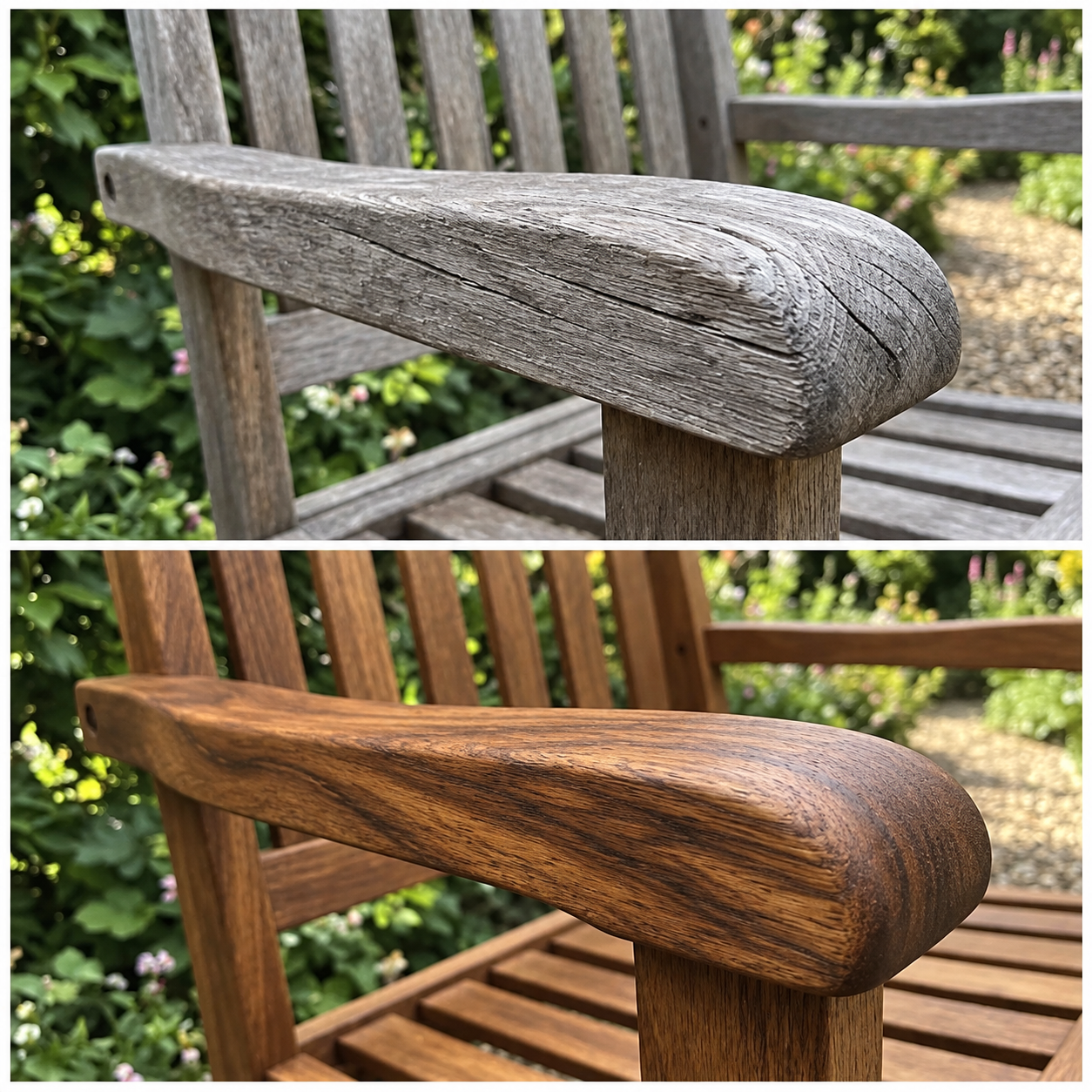
I feel stupid telling you this, because I'm about to talk myself out of a job. I've spent 26 years dragging outdoor furniture back from the dead... And I turn down more work than I take because most of the patio sets people want me to restore for $800 don't need the damn restoration. They need a $49 jar and a Saturday morning. You've been doing 5 things to your patio furniture that make it look ready for the scrap pile, and I'll bet you've done at least 3. Keep count as you read. I throw down that bet in every driveway I pull into, and I almost never lose, because not one of those 5 things ever stood a chance of working. Here's how the call usually goes. Someone calls me about their patio set. The teak has gone gray. Chalky gray smothers the tabletop, every chair arm scrapes like a cat's tongue, fuzz catches under their hand, and the bench snags a sleeve. They've decided to pay for a restoration or rip out the whole set and replace it, and they want me to name the damage. But nobody coughs up the real problem on that call. It isn't really about the furniture. The backyard should hold the whole summer, but somewhere over the last few years, they quietly quit inviting people out there. That embarrassment bites hardest right before company comes... When they're throwing towels over the chair arms... And herding guests into the kitchen because the evening light makes the best part of their house look like something they should apologize for. The deck used to pull everybody outside. Now they steer people around it. So most of the time, I climb out of the truck, drag my palm down a chair arm, and tell them to put the checkbook away. Their furniture has nothing wrong with it that $800 would fix. The wood is perfect. They've killed the surface themselves, the same 5 ways almost everybody does. So before you gut your wallet replacing a set that hasn't broken, let me show you what's actually happening, then name the 5 things. Keep count, but don't use the number to beat yourself up. In 26 years, I have never pulled into a driveway where the owner had done fewer than 3. These people loved their backyards. The products have failure built into them. You don't. First, let's drag the real problem into daylight. The top layer of every outdoor hardwood carries oil. Teak, acacia, and eucalyptus all carry it, whether the tree supplied it or the factory put it in. That oil alone keeps the surface fibers flexible. Sun pulls it out. Rain helps strip it. Heat helps finish the job. On a patio that takes the weather head-on, the surface layer can bleed out its oil in a summer or two. When the oil goes, the surface turns brittle, and brittle wood doesn't sit there looking smooth. It breaks down. Dirt didn't paint that gray across your tabletop, and age didn't put it there, either. Dried-out surface cells oxidize and scatter the light. Ordinary wear didn't raise that fuzz under your palm. Dead, brittle fibers stand up because nothing holds them down anymore. Those fine cracks along the chair arm show the surface splitting open, and every rain drives a little deeper in. The gray waves the warning flag. Dry wood causes the trouble. Hang onto that, because every one of these 5 mistakes makes sense once you understand it. Here come the 5. Mistake #1 starts with the pressure washer. You pointed it at the set, probably one Saturday when the wood looked like it needed a good blasting, and for about a week you thought you'd pulled off a miracle. But a pressure washer doesn't clean gray wood. It rips it off. The color came back because the machine blasted away the dead top layer, chewed into the grain underneath, and stripped whatever oil still held things together. You didn't clean the set. You sanded it with water, gouged it unevenly, and threw the door open to the weather. Every spring, pressure-washed sets rack up the fattest repair bills in my shop. That's one. Mistake #2 comes in a bottle marked teak oil. You bought the bottle with your furniture's name on it, wiped it on, and watched the wood glow for about 3 weeks. Then the finish fell flat, turned tacky as flypaper, grabbed every piece of pollen in the county, and disappeared by fall. There's no teak in teak oil. Most of it comes down to thinned linseed with solvent, and that solvent made it slip into the wood so nicely. The solvent flashes off in hours, and the thin oil follows it back out over weeks. Most of that bottle's contents have one job: evaporate. That's two. Mistake #3 hides in the cleaners and brighteners. This one kicks hardest because cleaning outdoor furniture counts as responsible ownership, and the hardware store sells those 2-step kits as "maintenance." But the cleaner strips whatever oil the surface still has, and the brightener bleaches the dead cells so the wood can fake freshness for a week. By August, you're staring at wood that looks paler, thirstier, and grayer than anything you started with. You kept your set clean, and the cleaning wrung it dry. That's three. And if you've done 3, don't think I've singled you out. Almost everyone whose driveway I pull into has done them, which explains why I keep making that bet without breaking a sweat. Mistake #4 wears the labels sealer, "restore" coating, and stain. Eventually, you hunted for something that would lock the color in, and the hardware store shoved a whole shelf of 4-year protection promises under your nose. For a season, the finish behaves itself. Then the sun burns it bare in the exposed spots while the shade hangs onto the shine, because a sealer over starving wood slaps a lid on an empty jar. Nothing sound underneath gives it a grip. You weren't protecting anything. You were shrink-wrapping wood that was already dying underneath. That's four. Mistake #5 starts when you decide to restore or replace. This one takes the biggest bite, and it pays my bills, which ought to tell you something when I tell you not to do it. By the time people call me, they've written the set off. They see only 2 exits: hand over $800 for stripping and refinishing, or cough up $2,000 to $4,000 for a new set with the same half-assed instructions rattling around in the box. And almost every time, perfect solid hardwood sits underneath 2 or 3 summers of dryness, with nothing wrong but a starving surface that a $39 jar brings back. You were about to replace furniture that isn't broken. That's five. Count them up. If you've done 3, I was right. If you've done 4, I was right. If you've done all 5 and the restoration quote sits on your counter right now, I'm especially glad I caught you before you signed it. And before you argue, do this: Drag your palm down the arm of the chair... And press a thumbnail gently into the underside of the table where it won't show. The top scrapes your palm. The wood underneath holds firm. Your own deck just told you the whole story. Now listen to this part, because I watch people lug this around like proof they screwed up. You didn't fail, and you didn't neglect it. You did the opposite. Every spring, you cleaned it, oiled it, sealed it, and faithfully looked after the best room in your house. The caring did the damage. The hardware store sold you cleaning and coating when your wood needed feeding, and nobody bothered to tell you those things don't do the same job. You followed every instruction from everybody who ever opened their mouth to tell you what to do. They were all wrong. The thing that actually works does what none of those products ever would, because nobody makes money selling you something you buy once a season. Real plant oil feeds the brittle surface until the fibers flex again, then beeswax seals it so the sun can't drag the oil back out. Feed it, then seal it. Plant oil feeds the wood, and beeswax seals the oil in. Your furniture hasn't suffered damage. It's starving. Let me show you what that looks like, because I know before-and-after pictures stopped earning your trust a long time ago. Last month, an owner called me to restore a 12-year-old teak dining set for $850. Gray smothered the table and all 6 chairs, and the rough wood scraped so badly that she'd quit resting her arms on it. She'd already picked out the replacement, and my restoration quote sat on the counter next to it. I asked her to give me one chair before she signed anything. While she watched, I rubbed a little of this onto the worst arm, on the chair by the back door. I worked it along the grain, let the wax set, and stepped back. The chalky gray gave way to dark, even, warm wood, and the color held when it dried. She didn't buy it, and she told me why: teak oil had looked good for 3 weeks, too. So I told her to leave it alone and check it after the next rain. Then check it again at noon, under the worst sun on the deck, the same merciless light that had dragged every flaw into view for years. She texted me 5 days later, after a storm. It had held. The arm stayed dry and even in full sun. She canceled the restoration and tackled the rest of the set herself in a morning. Your set matches what hers looked like before. Solid hardwood sits underneath that starving surface, with nothing actually wrong that a $39 jar can't bring back. I talked myself out of an $850 job that day, and I'd do it again, because I'd rather tell you the truth than pocket your money for furniture that wasn't broken. And I already know your next question, because everyone asks it before trying anything new on a set they're scared of making worse. Can it make things worse? No. The jar contains plant oil and beeswax. It contains no solvent, no bleach, and no coating, and it leaves you nothing to sand. At worst, you wipe a little wax off with a cloth. After everything else you've put on that wood, I'd want to hear that part, too. Do one chair first. Pick the worst one, the one by the door. Watch it after the next rain, then decide whether to believe a word I've said before you go anywhere near a restoration quote. You'll find the jar I hand people in their driveways below. I don't make a cent telling you about it. I just got sick of pulling into driveways to drop an $800 number on people when $49 told the truth. 👇 Start with your worst chair, the one by the door. While you wait for it to arrive, keep counting how many of the 5 you've done.
Performance Signals
- Status
- Still running
- Time Running
- 23 days
- Active Period
- Oct 9, 2026 → Today
- Advertiser live ads
- 1.4K
- First Seen
- Oct 28, 2026
Creative & Links
- Meta page ID
- 667404893120221
- Format
- Image
- Placements
- FACEBOOK, INSTAGRAM, AUDIENCE NETWORK, MESSENGER, THREADS
- Country
- 🇬🇧 United Kingdom
- Original Ad
- Open in Meta Ad Library
More from Luxgrove
See every ad this brand runs, with run dates, countries and the AI hook and angle of each.
Start 7-day free trialLuxgrove
getluxgrove.comLuxgrove
Shop Infos
- Created
- Sep 20, 2024 · 2y 2m
- Category
- Home & Garden › Home Furnishings › Living Room Furniture
- Live ads
- 1.4K
- Peak ads (7d)
- 1.4K
- Copies of this ad
- 1
Search every indexed Meta ad by niche, format, country and run time, save creatives to boards and track the brands behind them. 7-day free trial.