Based Supplies ad: Get Your Thick Hair Back!

Based Supplies
196 active ads🇺🇸
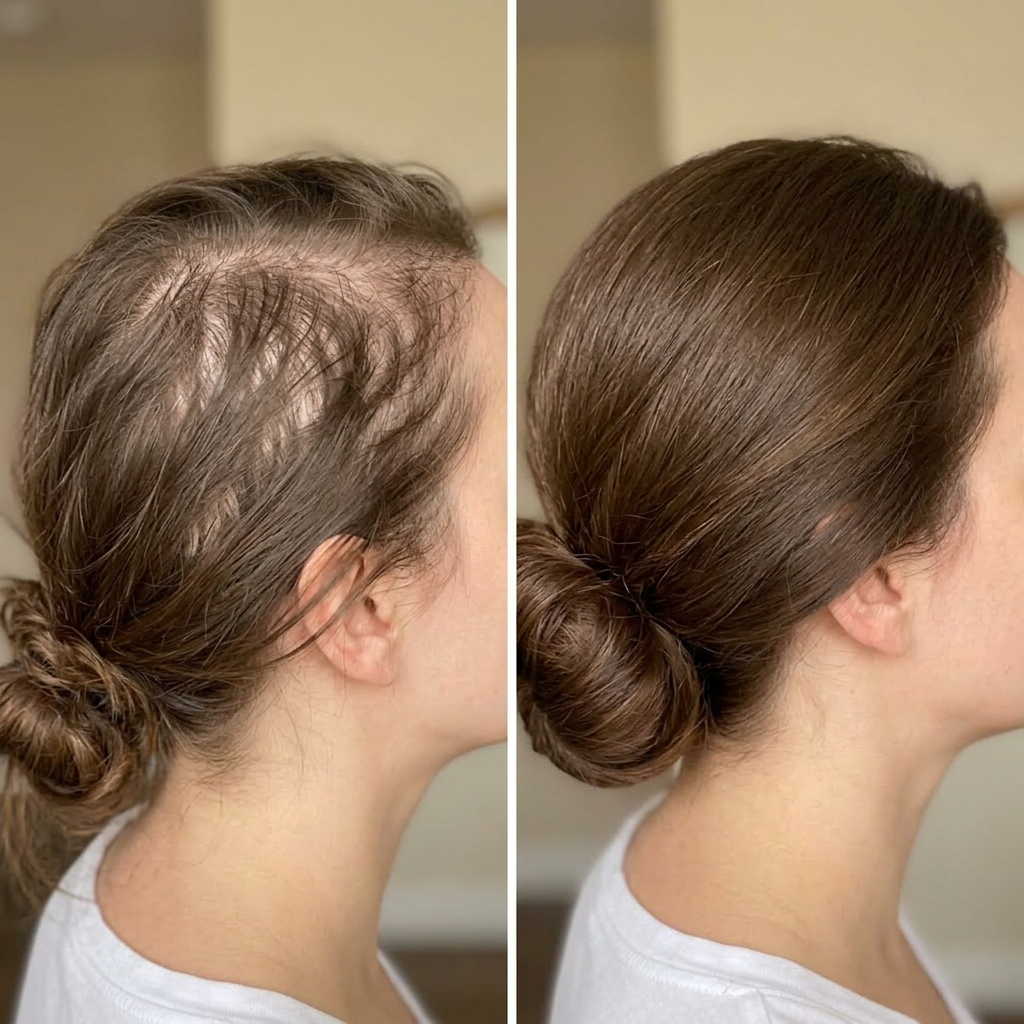
I have a drawer in my bathroom I don't let anyone open. Not because there's anything embarrassing in it. Well — maybe a little embarrassing. It's full of supplements. Hair supplements. Bottles and bottles of them. Some half-finished. Some barely touched. Some I forgot I even bought. Biotin. Collagen peptides. Nutrafol. Viviscal. A "hair skin and nails" gummy I found on TikTok at 2am. Something called "follicle fuel" that cost $70 and tasted like chalk. If you added it all up — and I did, one night when I couldn't sleep — I spent over $800 in fourteen months trying to stop my hair from falling out. None of it worked. Not one bottle. Not one capsule. Not one "carry a water bottle with collagen powder everywhere you go" routine that I stuck to for weeks. My hair kept thinning. My part kept widening. My ponytail kept getting smaller. And I kept buying more supplements. Because every blog post, every dermatologist TikTok, every "what I take for hair growth" video said the same thing: the problem is on the inside. You're deficient in something. Take this. So I took everything. And I want to tell you what actually changed — because it wasn't another pill. It wasn't another powder. It was a single question that someone asked me in a salon chair that made me realize I'd been solving the wrong problem for over a year. The moment I knew something was wrong I want to back up. Because I know there's a specific moment for every woman when hair thinning goes from "hmm, that's weird" to "something is actually wrong." For me it was a Tuesday morning in March. I was standing at my bathroom mirror, pulling my hair into a ponytail for work. And the elastic wrapped around four times. It used to wrap around twice. Maybe three times on a fresh wash day. Four times. I just stood there staring at it. This sad, thin little ponytail that used to be thick enough to hold a claw clip. I told myself it was stress. I told myself it was seasonal. I told myself I was imagining it. I wasn't imagining it. Over the next few weeks I started noticing everything. The hair on my pillow. The clump in the shower drain. The way my part looked under overhead lighting — you could see scalp where you never used to. I started angling my head away from people in meetings so they wouldn't see it. I became a detective of my own head. Checking the drain every morning. Counting strands on my brush. Taking photos of my part under the bathroom light to compare week to week. The photos didn't lie. It was getting worse. The supplement spiral I did what anyone would do. I Googled "why is my hair falling out" and fell into the deepest rabbit hole of my life. Every article said the same thing. You're probably deficient in biotin. Or iron. Or zinc. Or vitamin D. Or protein. Your body isn't getting what it needs internally, and your hair is the first thing it sacrifices. That made sense to me. I wasn't eating great. I was stressed. My body was probably just... running low on something. So I started with biotin. 10,000 mcg a day. The bottle said I'd see results in 60–90 days. Ninety days later: nothing. Same drain. Same ponytail. Same widening part. I added collagen peptides. Dumped a scoop in my coffee every morning. Waited another 90 days. Nothing. Then came Nutrafol. $88 a month. Four giant capsules a day. The reviews were incredible. Women posting before-and-afters with thick, full hair. "Changed my life," they said. I took it religiously for five months. Five months at $88. That's $440 on one supplement. My hair didn't change. I'm not saying those products don't work for anyone. I'm sure they do. But they didn't work for me — and I couldn't figure out why. I was doing everything right. Taking everything I was supposed to take. Eating well. Sleeping. Drinking water. Exercising. And every morning I'd look in the mirror, and every morning there was a little less hair. I started to believe it was just permanent. That this was just what my hair was going to be now. That I'd lost some genetic lottery and needed to accept it. That belief lasted until I sat down in a salon chair in October and a woman named Denise asked me one question. The question that changed everything I'd found Denise through a friend. She specializes in fine and thinning hair — she's not a dermatologist, she's a hairdresser, but she's the kind who's been doing this for 25 years and has seen more scalps than most doctors. She parted my hair. Looked at my scalp. Asked me what I'd been doing about the thinning. I told her about the supplements. All of them. She nodded. Then she asked: "What shampoo do you use?" I told her. It was a salon-quality brand. Not cheap. Something my last stylist had recommended. She flipped the bottle over. Read the ingredients. And then she said something that genuinely made me angry — not at her, but at myself. At everything I thought I knew. She said: "You've spent a year trying to fix your hair from the inside. But the problem isn't inside your body. It's on your scalp. And you're making it worse every time you shower." I asked her what she meant. She pointed to the ingredient list. Sodium lauryl sulfate. Sodium laureth sulfate. She told me these are industrial-grade detergents. They strip everything off your scalp — including sulfur. I said, "Sulfur? Like... the element?" She said yes. Sulfur is one of the most important building blocks of keratin, which is what your hair is literally made of. Your follicles need sulfur to function. To grow. To stay in their active growth cycle instead of going dormant. And every time I washed my hair — every single day — my shampoo was stripping it away. "You've been taking biotin and collagen to try to feed your hair from the inside," she said. "But it doesn't matter what you feed it if the environment where it grows is hostile. That's like planting seeds in concrete and then wondering why the fertilizer isn't working." Seeds in concrete. I've never forgotten that. The root cause nobody talks about That night I went home and did something I'd never done before. I researched shampoo the way I'd researched supplements. What I found made me sick. Sulfates — the foaming agents in almost every mainstream shampoo — are essentially the same compounds used in engine degreasers and dish soap. They're in shampoo because they create that satisfying lather. They make your hair feel "squeaky clean." But "squeaky clean" on your scalp means stripped. It means the natural oils, the balanced pH, and the sulfur compounds your follicles rely on are getting blasted away every 24 hours. And here's what got me: your body does try to replenish sulfur to the scalp. It does. But if you're washing with sulfates daily, you're depleting it faster than your body can replace it. It's like trying to fill a bathtub with the drain open. Your follicles don't die immediately. They go dormant. They shrink. They produce thinner, weaker strands — or they stop producing altogether. And from the outside, that looks like thinning. A wider part. A thinner ponytail. Hair on the drain. It's not that your body is broken. It's not that you need more biotin. It's that the surface — the actual scalp where growth happens — has been stripped of the one thing it needs most to do its job. And you've been doing it to yourself. Every morning. With a product you trusted. I sat at my kitchen table reading about this at midnight and I felt like an idiot. Not because I should have known — how would I have known? — but because I'd spent $800 and fourteen months looking everywhere except the thing I was putting directly on my head every single day. The shampoo she told me about Denise didn't just diagnose the problem. She handed me a bottle. It was an onion hydrosol shampoo. I'll be honest — when she said "onion" I made a face. She laughed. She said everyone makes that face. She explained: onion hydrosol is a concentrated extract that's one of the richest natural sources of sulfur you can put on your scalp. Not raw onion juice (which is messy and smells terrible). Hydrosol. A refined, concentrated form that delivers bioavailable sulfur directly to the follicle without the smell, the burn, or the hassle. This particular formula had 15% onion hydrosol. She said that's important — most "onion" shampoos on the market use trace amounts, like 1–2%, because the real thing is expensive. Enough to put "onion" on the label. Not enough to actually do anything. This one also had rosemary oil, which has actual clinical data behind it for hair density. Nettle extract, which blocks DHT — a hormone that shrinks follicles — directly at the scalp level. Peppermint oil for circulation. Biotin and castor oil for the follicle itself. But the star was the onion hydrosol. The sulfur delivery system. She told me to throw away my old shampoo — she actually said "throw it away tonight, don't give yourself a reason to go back" — and use this instead. Same routine. Same shower. Same amount of time. Just a different bottle. I asked her how long it would take. She said: "You didn't lose your hair overnight. You won't regrow it overnight. Give it 90 days and pay attention to your drain." Week 1–2: The adjustment I'm going to be honest about the full experience because I think the example ads that only show the good parts do people a disservice. The first thing I noticed: less lather. If you've been using sulfate shampoo your whole life, switching to a sulfate-free formula feels different. You don't get that big, foamy lather. It feels like the shampoo isn't "working." It is working. That lather was the problem. But it takes a few days to stop expecting it. The second thing: my hair felt different while drying. Not bad — just different. Softer, actually. Less of that stripped, squeaky feeling. The third thing — and this was hard: I was still shedding. Denise had warned me about this. She said the hairs that are already in their shedding phase are going to fall out regardless. You can't save a hair that's already decided to go. What you're doing is changing the environment so the next cycle is healthier. So for two weeks, I was using a new shampoo and still seeing hair on the drain. And the voice in my head was screaming, "This isn't working either. You're wasting your time again." I almost quit. I want to be transparent about that. Week 3–4: The first sign Three weeks in, I noticed the drain was... cleaner. Not dramatically. Not a miracle. Just — less. Where I used to see a web of hair every shower, now there were a few strands. I almost didn't trust it. I thought maybe I just wasn't looking as carefully. So I started photographing the drain. Every day after my shower. Same angle. Same lighting. The photos didn't lie. The shedding was slowing down. I also noticed my scalp felt different. Less dry. Less itchy. I'd had this low-grade scalp irritation for years that I thought was just dandruff or sensitivity. It was basically gone. Denise had told me this would happen. She said when you stop stripping the scalp every day and start delivering sulfur back to it, the scalp environment normalizes. pH balances. Oil production regulates. Inflammation goes down. She was right. My scalp felt calm for the first time in years. Week 5–8: The baby hairs Week five is when I saw them. I was doing my makeup in the morning, leaning close to the mirror, and I noticed tiny little hairs standing straight up along my hairline. Maybe half an inch long. Dozens of them. Baby hairs. New growth. I touched them. They were soft and fine, but they were there. Sprouting out of places that had been smooth and bare for months. I stood in my bathroom and cried. I'm not exaggerating. I stood there with mascara in one hand and cried because for fourteen months I'd believed my hair was just... gone. That this was permanent. That I'd tried everything and nothing worked. And here was my scalp, growing new hair. Because someone had finally told me the truth: the problem wasn't inside my body. It was on the surface. In the shampoo I was using every single day. By week eight, the baby hairs were everywhere. Along my hairline. Through my part. Around my temples. They were short and kind of unruly — they'd stick up at weird angles and refuse to lie flat — but I didn't care. I loved them. Every single one of them was a follicle waking back up. Month 3–4: The ponytail test At twelve weeks I did the ponytail test. Three wraps. Not four. Three. I pulled the elastic out and redid it just to make sure. Three wraps. I took a photo. Put it next to the photo I'd taken in March. Same elastic. Same mirror. The difference was undeniable. The ponytail was thicker. Not "Instagram miracle transformation" thicker. But real thicker. Visibly, tangibly, I can feel the weight of it thicker. My part had narrowed too. The photos showed it clearly — what had been a wide, visible stripe of scalp was now partially covered with new growth. Not fully — I want to be realistic — but the gap was closing. At month four, something happened that caught me completely off guard. A coworker — someone I see every day — looked at me in a meeting and said, "Did you do something different with your hair?" I hadn't changed my style. I hadn't changed my color. My hair was just... fuller. Enough that someone else noticed without being told. I went back to Denise that week. She looked at my scalp, smiled, and said: "Your follicles were never dead. They were dormant. You just had to give them what they needed." What I wish I'd known fourteen months earlier Here's what I think about sometimes: what if I'd known this from the beginning? What if, before I spent $800 on supplements, before I spent fourteen months watching my hair thin, before I lay awake at night convinced it was permanent — what if someone had just told me to flip my shampoo bottle over and read the back? I'm not anti-supplement. I'm sure biotin helps some people. I'm sure collagen has its place. But for me, taking pills to grow my hair while simultaneously washing it with a product that was stripping my scalp of the thing it needed most — that was like running on a treadmill and wondering why I wasn't moving forward. The problem was never inside my body. It was on my scalp. In the environment where hair actually grows. And the fix wasn't adding something new to my routine. It was swapping something I was already doing every day. Same shower. Same five minutes. Just a different bottle. The shampoo The product Denise gave me is by Based Supplies — it's an onion hydrosol shampoo and conditioner. 15% onion hydrosol concentration, which is the highest I've found anywhere. Most "onion shampoos" are 1–2% with the name on the label for marketing. This one is actually built around the ingredient. It also has rosemary oil (clinically studied for hair density), nettle extract (a natural DHT blocker that works topically — right where DHT actually attacks the follicle), peppermint oil (for scalp circulation), biotin, castor oil, argan oil, and aloe vera. It does not smell like onion. I need to say that because everyone asks. It smells clean and herbal — rosemary and peppermint are the dominant notes. My husband didn't even know I'd switched shampoos until I told him. It's made by a family business, not a giant conglomerate. They offer a 30-day money-back guarantee, which is how I justified trying it. I figured if it didn't work, I'd return it and go back to my supplement graveyard. I didn't return it. What I'd tell you if you were sitting next to me right now If you're reading this and you've been where I was — if you've tried the supplements, checked the bloodwork, changed the diet, and your hair is still thinning — I want you to consider something. Go to your shower right now. Pick up your shampoo bottle. Flip it over. Look at the ingredient list. If you see sodium lauryl sulfate or sodium laureth sulfate in the first few ingredients, you are washing your hair every day with an industrial detergent that is stripping sulfur from your scalp. You are planting seeds in concrete and wondering why the fertilizer isn't working. Your follicles might not be dead. They might be dormant. Waiting. Starving for the one thing they need to wake back up. You don't need another supplement. You don't need another $88-a-month pill. You might just need to change what's already in your shower. That's what worked for me. After fourteen months and $800 of trying everything else. One swap. Same routine. Different bottle.
Performance Signals
- Status
- Still running
- Time Running
- 22 days
- Active Period
- Oct 11, 2026 → Today
- Advertiser live ads
- 196
- First Seen
- Oct 29, 2026
Creative & Links
- Meta page ID
- 101757929032411
- Format
- Image
- Placements
- FACEBOOK, INSTAGRAM, AUDIENCE NETWORK, MESSENGER, THREADS
- Country
- 🇺🇸 United States
- Original Ad
- Open in Meta Ad Library
Campaign Tagging
- source
- medium
- social
- campaign
- {{campaign.name}}
- content
- {{ad.name}}
- term
- {{adset.name}}
Decoded from the landing page's UTM parameters — the advertiser's own campaign naming.
More from Based Supplies
See every ad this brand runs, with run dates, countries and the AI hook and angle of each.
Start 7-day free trialBased Supplies
basedsupplies.comBased Supplies
Shop Infos
- Created
- Dec 29, 2023 · 2y 11m
- Category
- Beauty & Fitness › Face & Body Care
- Live ads
- 196
- Peak ads (7d)
- 196
- Copies of this ad
- 2
Search every indexed Meta ad by niche, format, country and run time, save creatives to boards and track the brands behind them. 7-day free trial.