Pet Gently Homepage ad: It's Not Your Dog's Skin. It's Their Gut.

Pet Gently Homepage
100 active ads🇬🇧
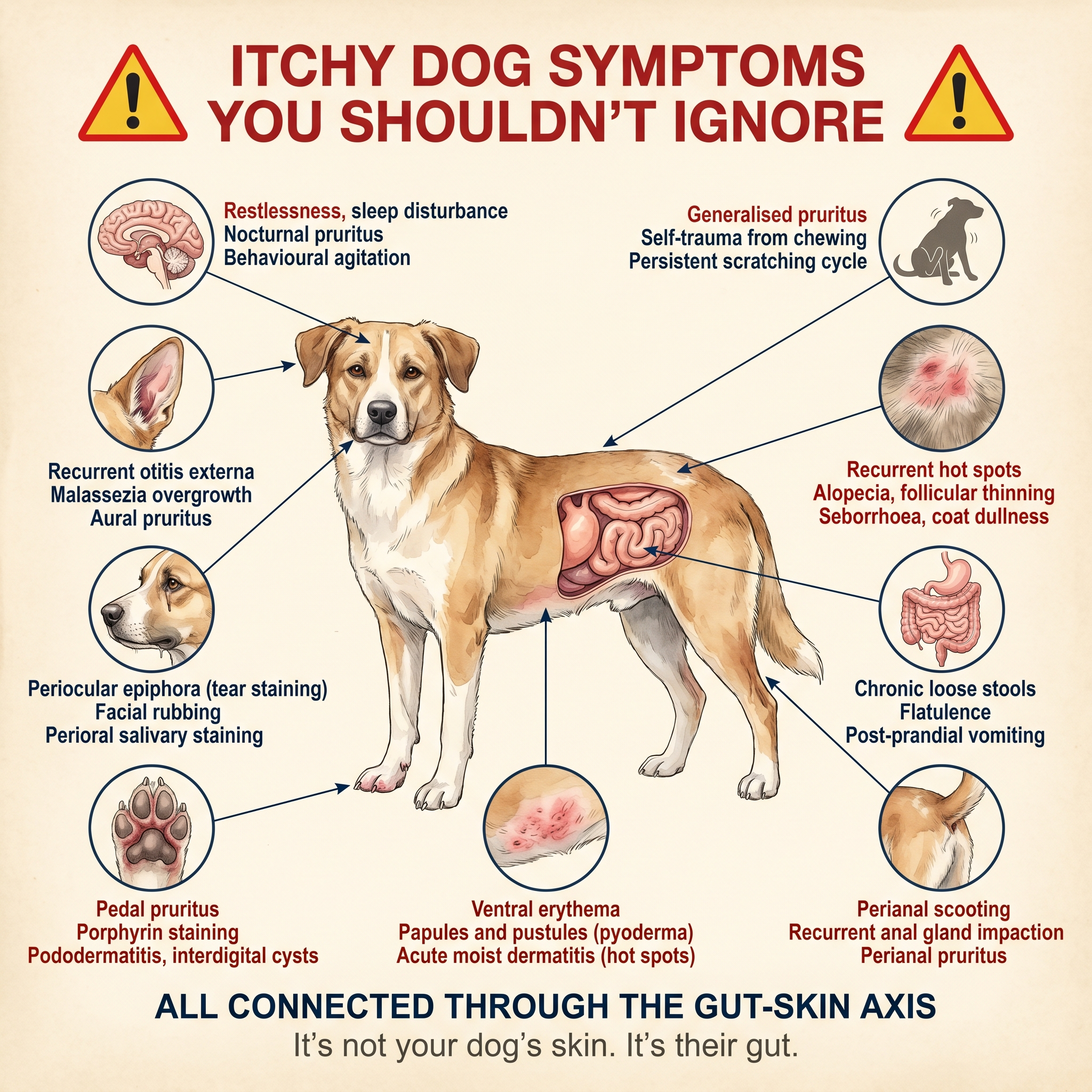
The Reason Your Dog Has Been Itching For Years (And Why Apoquel, Cytopoint And Special Shampoos Will Never Truly Fix It) If your dog has been on Apoquel for months and the rash keeps coming back, this post will tell you why. If you have tried Cytopoint injections, then steroids, then a hypoallergenic food, then a medicated shampoo, and your pup is still scratching at 2 AM, this post will tell you why. If you have spent thousands of pounds at the vet and the only thing that has changed is your bank balance, this post will tell you why. The reason has nothing to do with your dog's skin. It has to do with a part of your pup's body that holds 200 million nerve cells. These nerve cells make most of their serotonin, the chemical that keeps them calm and settled. They run most of their immune system, the defences that protect them from getting sick. They sit nowhere near the place where the itching shows up. Most vets have not yet joined the dots. The science is barely three years old. But the dogs feeling the effects can’t afford for textbooks to catch up. If your pup is one of them, this is what you need to know. The hidden epidemic in British dogs Researchers now estimate that one in three dogs is suffering from the same root problem. It drives almost every case of constant itching, paw licking, belly redness, ear infections and 2 AM scratching that owners describe in surgeries across the UK every day. Studies in dogs and humans both show the same thing happening. The numbers climb every year. Almost every owner of an itchy dog assumes their pup is unusual. They are not. They are one of millions, and the number grows every year. The question is why. A senior British vet I spoke with last year put it plainly. Today's dogs are not the dogs of fifty years ago. Your modern pup spends most of their life indoors. They sleep on the sofa. They walk on pavements rather than fields. They eat the same dry food twice a day for years on end. They live in cleaner houses, with more frequent baths, more frequent washing of their bedding, fewer other dogs in the household, and far less contact with the soil and grass and muck their ancestors lived alongside for thousands of years. Each of these changes, on its own, sounds harmless. Some sound positively good. Together, they have rewritten what it means to be a dog. And your pup's immune system has not had time to catch up. A study published in PLOS ONE confirmed what vets had been suspecting for years. Dogs raised in extremely clean homes get itchy skin problems far more often than dogs raised in normal homes. Dogs raised in detached houses, with other dogs around them, with garden access, suffer less. Dogs raised in flats, in cities, with no other animals in the household, suffer far more. The same study named the West Highland White Terrier, the Boxer, the English Bulldog, the Dalmatian and the French Bulldog as the five breeds most likely to suffer. If you have one of these breeds, your pup was already at higher risk before any other factor came into play. But this is not a story about bad luck or bad breeding. It is a story about an immune system built for one kind of life, asked to cope with a completely different one. The knowledge gap most owners have When a dog starts scratching, what happens next is almost always the same. You take them to the vet. The vet looks at the skin. They prescribe Apoquel for the itch, or Cytopoint injections, or a course of steroids. If there are infections on top, they add antibiotics. If the symptoms keep coming back, they suggest a hypoallergenic food trial. Or a medicated shampoo. Or allergy testing, which costs hundreds of pounds and rarely gives you a clear answer. All of this targets the skin. All of it covers up the symptom. None of it answers the question your dog's body is actually asking. If the skin is the place where the symptom shows up, where is the place where the symptom starts? For decades, this question went unanswered. Vets treated the skin because the skin was where the visible problem was. The idea that a dog's itching might start somewhere else entirely, somewhere nowhere near the skin, would have sounded a bit out there in a typical small animal practice ten years ago. That has now changed. The "second brain" hiding inside your dog Inside your pup's belly sits something most owners have never heard of. Scientists call it the enteric nervous system. They also call it the "second brain". The reason is simple. It is a network of around 200 million nerve cells running the length of your dog's gut, from their mouth all the way to their back end. These nerve cells are the same kind of cells you find in their actual brain. They use the same chemical messengers. They talk to each other, send signals, and run things on their own. Put it in scale: your pup's actual brain holds about 500 to 600 million nerve cells. Their gut holds roughly a third of that. It is, in a very real sense, a second brain hiding in their belly. Here is the part most owners find genuinely surprising. About 90% of the serotonin in your dog's body, the chemical that keeps them calm, settled and happy, comes from their gut, not their head. Around 70% of their immune system also lives there. Stop and think about that… The place we picture as just "where food goes in and waste comes out" is actually one of the most powerful control rooms in their entire body. It runs their mood. It runs the defences that fight off infection. It talks directly to their brain through a thick cable of nerves called the vagus nerve, like a phone line that never stops ringing. Researchers at Stanford, the Wu Tsai Neurosciences Institute, the Purina Institute and dozens of vet research groups all now agree on this point. The gut does not just digest food. The gut runs the show. Including, as it turns out, the skin. What the gut-skin connection actually means In 2022, researchers started publishing the first proper studies on the link between a dog's gut and their skin. By 2025, a paper in BMC Microbiology had confirmed what doctors in human medicine had been seeing for over a decade. Dogs with itchy, inflamed skin have measurably different gut bacteria than healthy dogs. Here is the simplest way to picture what is going on. Your pup's gut is home to billions of friendly bacteria. Picture them as a garden. In a healthy dog, that garden is full of variety. Different plants, different roots, different flowers, all working together to keep the soil rich and the weeds out. In an itchy dog, the garden has been overrun. The variety has collapsed. A few aggressive weeds have taken over. The good plants have died off. And the soil itself, the gut wall, has started to leak. When the gut wall leaks, things that should stay inside the digestive system escape into the bloodstream. Tiny bits of inflammation. Bacterial waste. Stuff the body was never meant to deal with outside the gut. These things travel around the body in the blood. They reach the skin. Once they arrive, they wake up the immune cells in the skin called mast cells. Mast cells work like a fire alarm system for the skin. In a healthy dog, they sit quietly. They only sound the alarm when something genuinely dangerous turns up. In a dog whose gut is leaking inflammation, those alarms become hypersensitive. They start going off at everything. Pollen. Grass. Dust. Things they should ignore completely. The result is the itching, the scratching, the redness, the bumps you see on your dog's skin. But the source sits in their gut. This is not folklore. It is research published in proper vet journals in the last three years. It explains why dogs on long-term Apoquel keep flaring up. It explains why dogs treated with antibiotics catch the same skin infections again three months later. It explains why medicated shampoo gives 48 hours of relief and then the symptoms come straight back. None of those treatments reach the gut. And the gut is where the problem lives. Why this hits dogs harder than it hits us Here is the part most owners do not realise. The same gut-and-skin link exists in humans too. But humans have built-in advantages dogs do not. We eat a wider variety of food. We meet more different bacteria through travel, work, going outside, mixing with other people. Human skin is built differently from a dog's. It is thicker. It is more waterproof. It keeps allergens out better. Your pup has none of these advantages. Their skin is much thinner than yours. It lets allergens through more easily. Their food, in most British households, is the same one or two things every day for years on end, which leaves their gut with almost nothing to work with. Their contact with the bacteria in soil, the kind that builds a strong immune system, only goes as far as what they pick up on a walk. Their contact with other dogs, other animals, the wider outdoor world, depends entirely on what their owner's life looks like. When vets and researchers say modern life is causing these allergies, this is what they mean. Dogs are paying the price of clean indoor living far more directly than their owners are. The same environment that gives a human mild hay fever can give a dog non-stop, year-round itching. This is why the rise in cases is steeper in dogs than in humans. And it is why treating the skin alone has stopped working for so many owners. What actually has to happen for the symptoms to clear For an itchy dog with a gut-driven skin problem, three things have to happen at the same time. Skip any one of them and the symptoms come back. First, replant the gut garden. Not by sprinkling a generic probiotic on their food and hoping for the best. The gut needs the right kind of friendly bacteria, paired with the right kind of food to feed them so they take root and stay, alongside the kind of fibre that helps repair the gut wall itself. Second, turn down the alarms in the skin. Quercetin, a natural plant compound found in apples and onions, settles the mast cells, the fire alarms, so they stop going off at everything. It does not block the itch after the alarm has already sounded. It stops the alarm going off in the first place. Third, repair the skin itself. Months of scratching, infections on top, antibiotics, and inflammation have done damage. Omega-3 from salmon oil, plant compounds from grapeseed, and turmeric work together to rebuild the skin from the inside. Gut. Immune system. Skin. All three. At the same time. This is why most supplements fail. They only tackle one of the three. A fish oil works on the skin. A probiotic works on the gut. An antihistamine works on the immune response. Each one does its job. None of them does all three. One out of three falls short. What this looks like in practice In the last few years, a small UK pet supplement maker has built a daily chew designed specifically around this three-part approach. Twelve active ingredients. Each one with a clear job. Psyllium husk and pumpkin seed fibre look after the gut wall. A targeted probiotic blend with burdock root prebiotic replants the garden. Quercetin settles the alarms. Turmeric and grapeseed calm the inflammation. Salmon oil and flaxseed repair the skin. Liquorice root, seaweed and vitamin C strengthen the gut wall and support the coat. One chew a day. Dropped in the food bowl. Owners report visible improvement starting in week three. Belly redness fades by week six. Inflammation clears and fur regrows by weeks eight to ten. Most dogs reach full resolution by week twelve. 93% of owners report visible improvement within 90 days. The maker offers a 90-day money-back guarantee that matches the full timeline. If it works, your dog has found what other treatments could not reach. If it does not, you pay nothing. For owners who have spent thousands of pounds on injections, tablets, shampoos and prescription diets without breaking the cycle, this is the first proper go in years at fixing the actual cause. You can read more, including the full ingredient breakdown and the thinking behind it, at 👉petgently.com/pages/skin-coat-itch-support-01. The bottom line Your dog is not unusual. They are part of a generation of British dogs paying the price of modern indoor life with their skin. Most treatments cover the symptom and leave the cause untouched, which is why nothing has held for long. The gut-skin connection is the part your vet has not yet explained to you. It is not your dog's skin. It is their gut. And it is treatable. 👉 petgently.com/pages/skin-coat-itch-support-01
Performance Signals
- Status
- Still running
- Time Running
- 158 days
- Active Period
- May 28, 2026 → Today
- Advertiser live ads
- 100
- First Seen
- Oct 28, 2026
Creative & Links
- Meta page ID
- 403692636160464
- Format
- Image
- Placements
- FACEBOOK, INSTAGRAM, MESSENGER, THREADS
- Country
- 🇬🇧 United Kingdom
- Original Ad
- Open in Meta Ad Library
More from Pet Gently Homepage
See every ad this brand runs, with run dates, countries and the AI hook and angle of each.
Start 7-day free trialPet Gently Homepage
petgently.comPure, transparent supplementation for dogs. Help them with joint issues, itchy skin and coat & general wellbeing.
Shop Infos
- Created
- Jun 30, 2023 · 3y 5m
- Category
- Pets & Animals › Pet Food & Supplies
- Live ads
- 100
- Peak ads (7d)
- 100
Search every indexed Meta ad by niche, format, country and run time, save creatives to boards and track the brands behind them. 7-day free trial.