TherapyWorkbookPress ad: The Moment My Body Finally Caught Up With What I Already Knew

TherapyWorkbookPress
28 active ads🇫🇷
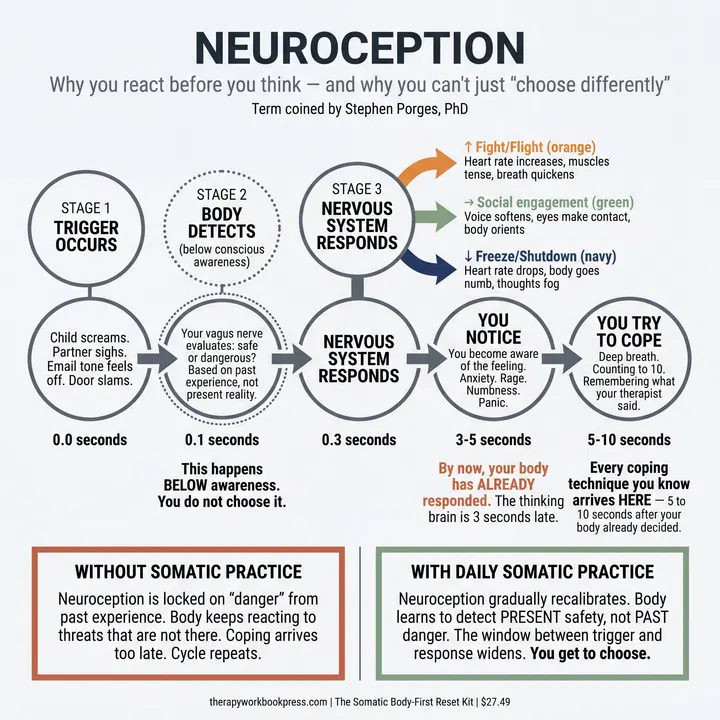
I read The Body Keeps the Score. Twice. The second time with a pencil. Then Complex PTSD by Pete Walker. Then Accessing the Healing Power of the Vagus Nerve. Then Attached. Then The Myth of Normal. About $120 in books. One shelf, then a second shelf. I paid $69.99 for a year of Calm. I kept a 41-day streak going. I bought a $297 online nervous system course from a somatic coach I followed on Instagram. Twelve modules. I finished nine. I did a year of talk therapy, every other week, at $140 a session. I don't regret a minute of it. It gave me words for everything. Magnesium glycinate. Ashwagandha. A $189 weighted blanket. Yoga every Tuesday. Journaling every morning. Three full notebooks of patterns, triggers, and the childhood reasons behind all of it. Almost three years. Over $4,500. And here's the part nobody warns you about. I understood all of it. I could explain my attachment style. I could name my triggers. I could tell you exactly where it all started, and on a good day I could even predict it. I knew why I was anxious. I just couldn't stop feeling it. I still spent forty minutes psyching myself up to make one phone call. I still cancelled dinner with my friends an hour before, because my chest went tight and the restaurant suddenly felt impossible. I still read my boss's two-word message five times, heart pounding, before I could answer it. After a while I stopped telling people about the books. It felt like a confession. I had become an expert on my own problem, and it hadn't moved an inch. If that's you too, hear this: you're not crazy, and you're not doing it wrong. These things really don't do what you bought them to do. Here's why. The turn came from something small. I was standing in my kitchen reading a text from my sister, and I noticed my shoulders were already up near my ears. My jaw was clenched. My heart was going. I hadn't had a single worried thought yet. I was still reading the text. My body had reacted before I'd understood anything. So for a week I tested it. Every time the old reaction came, I asked one question: what came first, the body or the thought? Every single time, it was the body. The thought arrived after, already explaining. Then I looked at my shelves differently. Different authors. Different methods. Different price tags. The $18 book, the $70 app, the $297 course, the $140 sessions. But they all failed me the same way. Every single one started with an explanation. Understand why, and it will ease. That was the promise underneath all of it. And I had understood why. Years ago. That's when I stopped reading self-help and started reading the research. And I learned something that changed everything. The neuroscientist Joseph LeDoux spent decades on this. The system that fires the reaction and the system that understands it are two separate systems. His research even found a shortcut, a fast route that lets the alarm go off before the thinking brain has finished processing what's happening. The therapist Deb Dana, who trains other therapists, puts it in three words: story follows state. The body shifts first. The mind writes the story afterwards to explain it. Read that again, because it explained my entire shelf. Every book I read went to the same place: the part of me that understands. The podcasts. The course. The journal. Even therapy, which I valued. All of it spoke to the thinking part of me. My therapist was good. She helped me see the pattern clearly. But seeing the pattern happened in the part of me that sees. And the thinking part of me had learned a great deal. But the thinking part was never the one reacting. The books weren't wrong. I want to be fair about that. The Body Keeps the Score itself argues for working through the body, not just talking about it. I had underlined those pages. I just never did anything with them. Then there was Calm. I was practicing there, at least. But I did the same breathing exercise every morning, whatever state I woke up in. Some mornings it helped. Some mornings it did absolutely nothing, and I decided I was bad at breathing. Dana's work explained that too. Your body is not in the same state every day. On a revved-up day, a long slow exhale brings things down. On a shut-down day, there's nothing left to bring down, and the same exercise can leave you flatter than before. I'd been using a calming tool on days that didn't need calming. I'd been treating a foggy, far-away Thursday like a racing Tuesday. And then the research on how a learned reaction actually changes. Mohammed Milad and Gregory Quirk reviewed ten years of it. A reaction fades through repeated, safe experience in the body. Not through argument. Not through understanding why. And practice doesn't delete the old reaction. It builds a newer one beside it. The old one can come back on a hard day or in a new place. That's exactly why, every time I thought I was finally past something, it came roaring back. Of course it did. I had never practiced anything. I had only studied. The magnesium and the weighted blanket helped me sleep a little better. They never touched the moment my chest went tight at a restaurant. Nothing on my shelf was built for that moment. Every solution I'd tried was solving the wrong problem. They were all trying to make me understand more. But the problem was never understanding. The problem was the state my body was in. I almost didn't buy anything else. I'd spent $4,500 on things that were supposed to be different. I was done. When I found the Complete Somatic Nervous System Regulation Bundle, my first thought was: great, seven more PDFs for the shelf. But the product page opened with a Tuesday and a Thursday. The same exercise working one day and doing nothing the next. That was my Calm streak. Exactly. Nobody had ever described it to me before. So I kept reading, looking for the catch. The part where it would explain my childhood to me again. It never came. Here's what made it different. It doesn't start with an explanation. It doesn't start with your childhood, or your attachment style, or another chapter on trauma. It starts on page 13 with a 60-second check. One question none of my books had ever asked: what state is my body in right now? Revved up, shut down, or steady. Then it points you to the techniques built for that state. Not the same exercise every day. The one that matches the day. Every app I'd tried gave me one tool for every state. Every book gave me more understanding. This gave me less information and the right practice. Different starting point entirely. The body's state, not the story. There are 13 techniques matched to each state in the first workbook. The second workbook has 41 body-based exercises, each marked for the state it serves. Most take a few minutes. There are 48 printable coping cards, one technique per card, for the days when even a full page is too much. And the breathing practice on page 31 is the one a Stanford team tested in a month-long trial with 108 people. Five minutes a day of structured breathing lifted mood more than mindfulness meditation did. A real trial. Not a wellness influencer's opinion. I bought it on a Sunday night, half expecting to prove myself right. Monday morning, before work, I sat in the car and did the check on page 13. I expected "revved up." I'd been calling it anxiety for three years. It came out "shut down." I sat there for a second. Three years of calming exercises on shut-down mornings. No wonder they did nothing. I did one exercise from the shut-down section. Four minutes. And for the first time that week, I could actually feel my feet on the floor. Here's what happened after that. Day 1: The check said "shut down." Four minutes. I felt my feet on the floor for the first time in days. Day 3: I stuck one coping card on the fridge and one in my wallet. The first things from my shelf that ever left the house. Week 1: The phone call I'd been avoiding for nine days. I did the check. Revved up, this time. I did the three-minute exercise for that state, and I dialed. Forty minutes of dread, down to about five. Week 2: The dinner. I went. I stayed for dessert. I didn't spend the whole meal planning my exit. Month 1: I was catching my body before the story, nine times out of ten. Shoulders first, then the worry. I answered my boss's message the first time I read it. Month 3: I haven't cancelled a plan since June. I don't brace before every text anymore. The card on the fridge is curling at the edges. I haven't bought another book. Hard days still come. The research said they would. The difference is that now I know exactly what to do with my body when they do. Last week my sister texted. I noticed my shoulders, did the two-minute card from my wallet, and replied before my coffee went cold. Such a small thing. It's the thing I had wanted for three years. The constant bracing is gone. I'm not the expert on my own problem anymore. I'm just someone who knows which state she's in, and what to do about it. My body finally caught up with what I already knew. Look, I spent over $4,500 on things that taught me why. I'm not going to pretend this is expensive. It's $37.49. Here's what that gets you, the Complete Somatic Nervous System Regulation Bundle, seven PDFs: The Nervous System Regulation Workbook: 50 pages, the 60-second state check on page 13, and 13 techniques matched to each state. The Vagus Nerve Stimulation Workbook: 41 body-based exercises, each marked for the state it serves. The Chronic Pain and Nervous System Tracker: daily, weekly and quarterly pages, so the pattern shows up on paper instead of in your head at 2 a.m. Somatic Coping Cards: 48 printable cards, one technique each. Three quick guides: a Polyvagal Theory primer, quick-reference sheets, and a clinician handout pack. Instant download. Opens on your phone, tablet or laptop. Prints on A4 or US Letter. The list price is $185. It's $37.49. 410 people have reviewed it. Average rating: 4.92. And the guarantee: use it for 60 days. If you don't feel the difference, or it just isn't right for you, send one email. Full refund. You keep the files. You risk $0. Either your body finally starts catching up with what you already know... Or you get every cent back. Get the Complete Somatic Bundle, 60-Day Guarantee I can't make you try this. But I can tell you what I wish someone had told me $4,500 ago. The problem isn't that you haven't found the right book. Or the right app. Or the right podcast. The problem is that all of them talk to the part of you that understands. And the part of you that reacts doesn't read. Story follows state. Change the state first, and the story follows. Once I understood that, the solution was obvious: check the state, match the tool, a few minutes a day. That's what this bundle does. I spent three years understanding my anxiety. Three years of streaks, shelves and notebooks. Three years I can't get back. Every month I spent reading was another month of cancelled dinners and forty-minute phone calls. You know why now. The choice is yours. Try the Complete Somatic Bundle Risk-Free To finding what actually works, P.S. The 60-day guarantee means you risk nothing. If your body doesn't start catching up with what you know, you get every penny back and keep the files. But if it works, if starting with the state instead of the story does for you what it did for me, you'll wish you'd known about this three shelves ago.
Performance Signals
- Status
- Still running
- Time Running
- 19 days
- Active Period
- Oct 15, 2026 → Today
- Advertiser live ads
- 28
- First Seen
- Nov 1, 2026
Creative & Links
- Meta page ID
- 103734905086194
- Format
- Image
- Placements
- FACEBOOK, INSTAGRAM, AUDIENCE NETWORK, THREADS
- Country
- 🇫🇷 France
- Original Ad
- Open in Meta Ad Library
More from TherapyWorkbookPress
See every ad this brand runs, with run dates, countries and the AI hook and angle of each.
Start 7-day free trialTherapyWorkbookPress
therapyworkbookpress.comTherapy worksheets, mental health workbooks & healing resources for professionals and personal growth. Evidence-based tools for anxiety, trauma, PTSD, inner child healing & self-discovery. Trusted by thousands of therapists, counselors & individuals worldwide. Instant PDF downloads ready to print and use today.
Shop Infos
- Created
- Dec 19, 2025 · 11 months
- Category
- Health › Mental Health › Social Services
- Live ads
- 28
- Peak ads (7d)
- 28
- Copies of this ad
- 2
Search every indexed Meta ad by niche, format, country and run time, save creatives to boards and track the brands behind them. 7-day free trial.