Eye&Ease ad: Read this if you have macular degeneration☝️

Eye&Ease
100 active ads🇭🇰
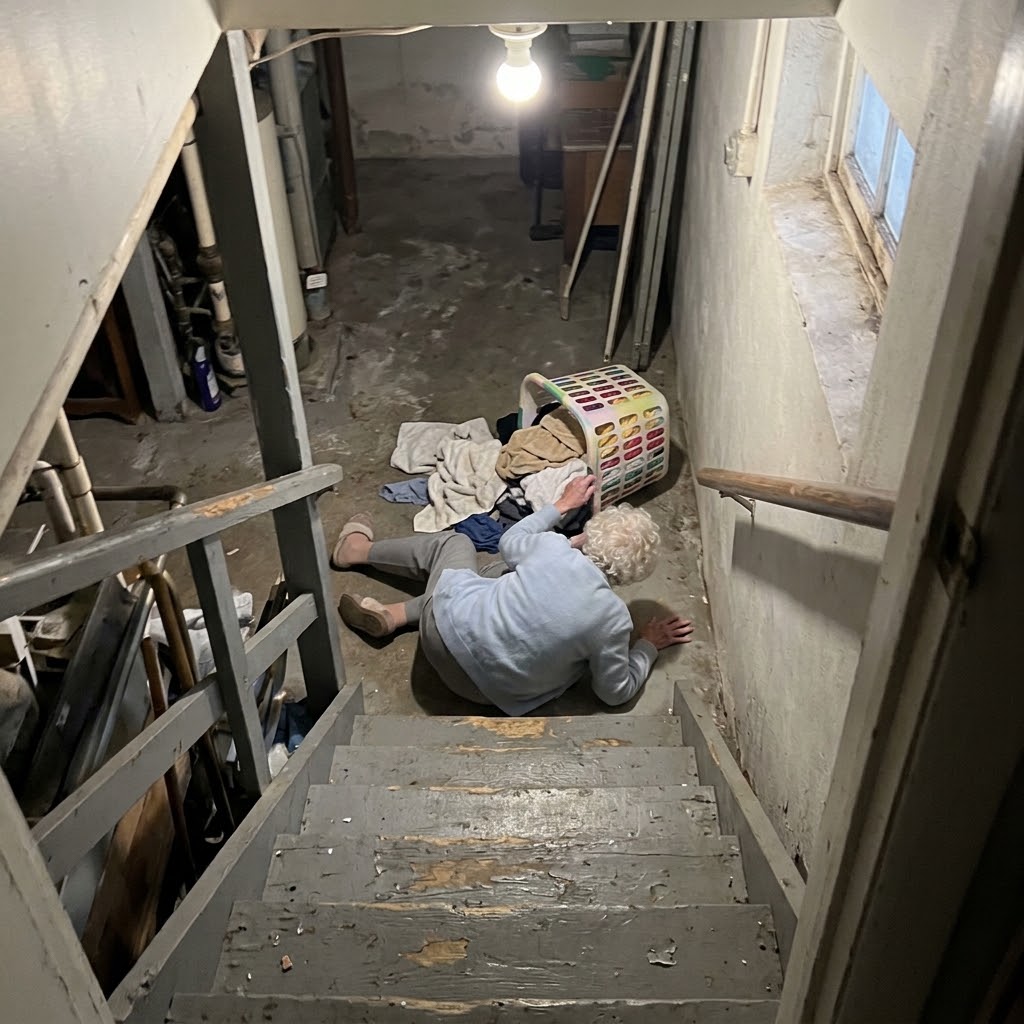
Macular degeneration has a part your eye chart can’t see. It’s the part that put me in hospital. I have macular degeneration. Two weeks before I broke my hip, I still read the eye chart a long way down at my check-up. Nobody at the eye clinic ever asked me about stairs. If you’ve started losing where your feet are, and you’ve put it down to your age or to being a klutz, I did exactly the same thing for a year. I want to tell you what that chart couldn’t see, and what happened on my basement stairs ten weeks after I found out. In March I was carrying a basket of towels down to my basement. The stairs are grey and the floor at the bottom is grey concrete, and there's one bulb on a chain. I put my foot down for the last step. It wasn't there. I don't remember landing. I remember the basket rolling away from me, and a sock near my face, and knowing very calmly that something in my left hip was wrong. Then the pain arrived. My phone was upstairs on the kitchen table. From the floor I could see my mother's old wheelchair, folded against the wall by the boiler, where it's been since she died. I lay on that floor for two hours and forty minutes, until my daughter let herself in with her key and heard me calling. My name is Emily Brown. I'm 68. I taught chemistry to fifteen-year-olds for 34 years. I'm not a doctor and I've never sold anything. What I'm good at is reading a label and finding the mistake in it. I did it to lab reports for three decades, and I still do it in the supermarket, which my daughter finds unbearable. Lying on that floor, I could only think about my mother. She went down a step too, twenty-six years ago, and she never went home. She was seventy-four. She'd gone out to get the post. There are four brick steps down from her front door. She missed the last one and landed on her side, and the letters went all over the path. Her hip broke in two places. After the surgery and the rehab ward there was a meeting where a woman with a clipboard said "long-term placement," and my mother looked at me like I'd know what that meant. She spent the next six years in a home with a lift and no stairs, most of them in that wheelchair. I pushed her round the garden there every Sunday. Three weeks before the porch step, her eye doctor had told her there wasn't much more they could do but keep monitoring it. Last year a retina specialist turned her screen towards me. dry macular degeneration, both eyes. The same thing my mother had. She said there wasn't much more we could do but keep monitoring it, and told me to take PreserVision AREDS2. So I did. Every morning for a year, with a queasy hour after it that I put down to my age. I took it the way I used to make students wear goggles. No exceptions. And for most of that year I was hiding something from my daughter. I'd started finding the last step of the basement stairs with my heel. I held the rail with both hands on stairs I've walked for forty years and told myself it was the bifocals. (I'd had those bifocals for nine years.) I poured my morning coffee with one finger hooked over the rim of the mug, so I'd feel it before it overflowed. Carol, my friend from two doors down, has the same thing in her eyes. She'd fallen twice that winter, once outside the supermarket with her oranges rolling under somebody's car. So we walked to the pharmacy arm in arm, and at every kerb one of us would say "step" and the other would hold on. Two old women holding each other up. In February I missed a step on the stairs in my hallway and spilled a full mug of tea down the carpet. My daughter saw the stain. "I slipped on the rug," I said. She knew there was no rug there. She didn't say anything. At the hospital they put two screws in my hip. That wasn't what broke me. On the day they let me go, a nurse came to show us the walker and a leaflet about falls. She explained all of it to my daughter. Slowly, the way I used to explain a titration to a fifteen-year-old who hadn't been listening. Then she turned to my daughter and asked, "Does she have a bedroom downstairs?" My daughter answered for me. The hip wasn't the worst part. The worst part was the first Sunday home. There was a real estate listing stuck to my fridge. A one-floor apartment, ten minutes from my daughter’s, with a walk-in shower and grab rails in the bathroom. She’d printed it out and left it there for me to find. There was a different one the next Sunday. I knew exactly where that road went. I'd driven my mother down it. The falls clinic sent me for an eye test. I read the chart on the wall a long way down, black letters on a white board, and I could still do it. Then the optometrist held up a different chart, where the letters stay the same size and fade into the page. I stopped a couple of lines in. She scanned the back of my eyes too. The drusen had spread since my last scan. "About what we'd expect," she said. The hospital had already scanned my head and found nothing. The physio spent six weeks on my leg and said the muscles were coming back nicely. Every person who looked at me after that fall found nothing wrong with the part they were looking at. And every one of them was doing their job properly. The edge of the step just wasn't anybody's job. I'd never have worked out whose job it was if Carol hadn't stepped off a kerb in May. It was my first trip to the pharmacy without the walker. I had a stick, and Carol had my other arm, out of habit. At the kerb she let go of me and stepped down on her own. "Your knee's better," I said. "It was never my knee," she said. "I've been taking a vitamin." She said it the way you'd tell somebody the bus times. She took a bottle out of her handbag. A brand I’d never heard of, which in my experience is usually a bad sign. So I did what I do. I put my reading glasses on in the pharmacy car park and read the label the way I used to read a lab report, looking for the mistake. There were three numbers on it I’d never seen on mine. I took a photo of the label. That night I didn’t go near the company’s website. I went to PubMed and read the peer-reviewed studies themselves, the way I used to make my students do before they were allowed to quote anything. I read until the paper came through the door. For thirty-four years I ground spinach with a pestle in front of a class and watched a yellow band creep up a strip of paper. Lutein. I never once asked where it goes after you eat it. It goes to the back of your eye. The very centre of the retina is yellow. Doctors call it the macula lutea, the yellow spot, and the yellow is pigment: a thin filter laid over the middle of the retina, soaking up the harsh blue part of daylight before it reaches the cells underneath. Think of the yellow lenses a skier wears on a grey afternoon. Without them the slope is one flat sheet of white. With them, every dip has an edge. With a thick filter, a grey step stands out from a grey floor. Let it thin and the two run together. That was the step I didn't see. It's the same family of pigment that turns an egg yolk yellow and a pepper orange. That's why every eye doctor tells you to eat your colours. It's the right advice. It's nowhere near enough. Your body can't make these pigments from scratch. Every bit of it back there, you ate. To match what the researchers used, you'd need something like two full bags of raw spinach a day, every day, for years. I've ground up more spinach for teenagers than I've ever eaten. Most of us manage a handful a week. So the centre runs on a store laid down decades ago, and the store covers the shortfall quietly, until it can't. Nothing changed the year I turned sixty-seven. The reserve just ran out. The disease is real, and age is real. But one piece of that missing edge is neither, and it's the one piece nobody had handed me anything for. And nobody measures it. The eye chart is black letters on a white board, the strongest contrast there is. A grey step at dusk was never on that chart. That's what they'd been monitoring. But the amount wasn't the part that got me out of bed. The filter has a ring and a centre. Lutein holds the ring. The very centre, the part you aim at the edge of a step, is built from two others, and one of them, meso-zeaxanthin, is in almost no food on earth. So the eye makes its own. When lutein reaches the eye, an enzyme there turns some of it into meso-zeaxanthin. But only some. On its own, it's nowhere near enough to fill the centre. Meso-zeaxanthin is its own molecule with its own job. I could have swallowed three of my capsules a day and the centre still wouldn't have filled. A team in Ireland tested exactly that. They gave people with early macular degeneration twice the lutein in my bottle, and no meso-zeaxanthin. After a year, the pigment had only risen at the outer edge. The people also given meso-zeaxanthin rose at every point they measured. I got up, found the walker in the dark, and went to the bathroom cabinet. My PreserVision AREDS2: ten milligrams of lutein, two of zeaxanthin. Meso-zeaxanthin: nothing. The AREDS 3 the pharmacist kept pointing me towards: more vitamins, less zinc. Meso-zeaxanthin: still nothing. A year of every single morning, building the ring of the filter while the centre sat empty. That formula was settled before most of the work on the centre came out. It still sells, and nobody rewrites a label that still sells. I'd done exactly what I was told for a year. Nobody had ever treated the middle. No wonder. By morning I knew exactly what I was checking Carol's bottle for. I wanted everything my specialist wanted, so I'd lose nothing from the protocol, with the zinc at 25 so I could keep taking it. And I wanted all three pigments at doses that could actually reach the centre. Most formulas skip meso-zeaxanthin entirely. One of the brands with a long list of ingredients on the label carries 2mg. That number bothered me more than the zero. A zero at least tells you it isn’t there. In that Irish research, the groups whose pigment rose at every point were taking 10mg of meso-zeaxanthin or more. 2mg is a fifth of the smallest dose they used. And you don’t absorb everything you swallow. These pigments dissolve in fat, not water (I taught that one with a separating funnel every autumn), so they need fat to get in, and how much makes it varies from person to person. Start at 2mg and what reaches the eye is a fraction of a fraction. The centre, the part you aim at the edge of a step, was never going to fill on that. 10mg is the dose the research used. It’s also the margin for the part you never absorb. Carol’s bottle was called MaculaCore. It had 10mg of meso-zeaxanthin and 6mg of zeaxanthin, three times my old bottle. But the number that surprised me was the lutein. Ten milligrams of lutein. That's my bottle. It's most of the others too, even the ones that match the 10mg of meso. When researchers pooled the trials in people with macular degeneration, 10mg a day didn't move the pigment enough to count. MaculaCore carries 30. Lutein has the same problem as the meso. You never absorb all of it. Some never gets past the gut, and how much does changes from person to person. Remember that enzyme? The lutein that gets through has two jobs. It holds the outer ring. And it's what that enzyme turns into meso-zeaxanthin, more for the centre on top of the 10mg in the capsule. Ten milligrams, cut down by absorption, then split across two jobs. That was my bottle. Thirty leaves room for both. There were three more I hadn't expected. Bilberry, 200mg, for the tiniest blood vessels at the back of the eye. The pigment can only do its job if it gets delivered. Saffron, 20mg. It's been studied for helping the light-sensing cells hold up under stress, and those are the cells the filter is there to protect. And astaxanthin, 4mg, one of the few antioxidants that can actually reach the retina. So the pigment builds the filter, and the other three make sure it arrives and that there's something left underneath worth protecting. I still didn't order it that day. I've been burned by hope before, and so has every woman in my retina clinic's waiting room. What made me order was that it was third-party tested in the US, and there’s a 90-day money-back guarantee. If it did nothing for me, I’d send it back and lose nothing. When it came, I did what I'd have done in the lab. I pulled a capsule apart over a white saucer. Real pigment has a colour of its own. That's the whole reason the centre of your eye is yellow. A red softgel gets its red from dye in the shell. A chalk-white tablet is often whitened with titanium dioxide, which Europe took out of its food in 2022. Either way, you can't see what's inside. This powder was a deep brown-orange, the same colour all the way through. No colouring on the label. The pigment comes from marigold petals. That colour told me two things. It was natural. And it was a real dose. Week one, nothing. I wrote "nothing" in the notebook by the kettle (old habit: I made students write down the experiments that failed too). By week four my eyes weren't as heavy in the evening. I didn't trust it. Then I poured my coffee into a white mug on a white counter, and halfway through I realised my finger wasn't on the rim. In week seven, Carol and I came out of the pharmacy and stepped down off that kerb. Neither of us reached for the other one. It was week ten that got me. The physio had cleared me for stairs two weeks before. I took half a basket of towels down to the basement. Same stairs. Same bulb. I saw where the last step ended before my foot got there. I stood on it. I stood on it for a long time. In week twelve the optometrist held up the fading chart again. I kept reading past the line where I’d stopped in April. Then she ran the scan and put it up next to April’s. She went from one to the other a few times. The drusen hadn’t spread. She looked at the screen, then at me. “What have you been doing?” I told her about the filter and Carol's bottle. She wrote something down and closed the folder. "Well. Keep doing whatever you're doing." I'm not going to print my numbers. I don't want anyone reading them as a promise. In the car park I sat down on the low wall and put both hands over my face. My daughter stood there holding my stick. "Mum? What did she say?" "She said keep doing it." Two Sundays later my daughter came for lunch. I went down my front steps to meet her, four brick steps like my mother's, and I was looking at her face the whole way down instead of at my feet. She saw. She didn't say anything. After lunch I went to put the kettle on, and the flat listings were gone from the fridge. She'd taken them down while I was out of the room. Neither of us has mentioned it since. I’d spent a year hiding a fall from my daughter. I wasn’t going to hide this. There are four of us at church with macular degeneration, and every one of us has had a wobble on the altar step at some point. I told them. Two of them have told me what they’ve noticed after four weeks. “I saw the kerb before my foot did.” “I went up for communion on Sunday and didn’t need anybody’s elbow.” And none of them has given up the stick or the physio. I won’t let them. So that’s what it actually was. Both our eye doctors were watching the eye, and nobody was looking at the filter sitting over the middle of it. Two weeks before my own fall, a retina specialist told me there wasn't much more we could do but keep monitoring it. Word for word what my mother was told. My mother never went home. I came home on a walker, with two screws in my hip and a real estate listing on my fridge. And her wheelchair still folded at the bottom of my basement stairs, where I'd lain for two hours looking at it. My mother spent six years in that home, and her eyes kept going in there. By the second year she couldn't read the dinner menu on the dining-room door. By the fourth, a nurse walked her to her own chair at lunch. Every Sunday she asked me when she could go home, and every Sunday I said soon. Her eyes never put her in that home. The step did. And once she was in it, nobody did anything for her eyes either. That filter does more than show you the edge of a step. It stands between the harsh light and the cells underneath. Let it thin and more of that light gets through to them, and those cells don't grow back. The step is the part you can see. The thinning is the part you can't. I nearly gave Carol her bottle back in that car park. I'd have waited six months for my next appointment, the way my mother waited for hers. Try MaculaCore for 90 days. Take it every day, as the label says. Keep the stick and the physio and every appointment. Pick one edge, the bottom step or the kerb outside your pharmacy, and watch it. If anything changes suddenly, that's a phone call to your eye doctor, not a capsule. There's a 90-day money-back guarantee. If you see no difference, you pay nothing. You can start refilling that filter now. Or you can keep monitoring it, the way my mother did. 👉 https://eyeandease.com/products/maculacore-eye-vitamin Emily Brown, 68, retired chemistry teacher P.S. MaculaCore is made in small batches and it has sold out before. When it does, the wait for the next run has been several weeks. If the page says in stock when you get there, I wouldn't sit on it.
Performance Signals
- Status
- Still running
- Time Running
- 1 day
- Active Period
- Oct 29, 2026 → Today
- Advertiser live ads
- 100
- First Seen
- Nov 1, 2026
Creative & Links
- Meta page ID
- 971338302723133
- Format
- Image
- Placements
- FACEBOOK, INSTAGRAM, AUDIENCE NETWORK, WHATSAPP, THREADS
- Country
- 🇭🇰 Hong Kong SAR China
- Landing Page
- eyeandease.com/products/maculacore-eye-vitamin
- Original Ad
- Open in Meta Ad Library
More from Eye&Ease
See every ad this brand runs, with run dates, countries and the AI hook and angle of each.
Start 7-day free trialEye&Ease
eyeandease.comEye Health Supplements & Heated Eye Masks Premium lutein-based eye supplements for macular health & Heated eye masks for dry eyes and eye fatigue. Trusted eye care from Eye&Ease.
Shop Infos
- Created
- Sep 26, 2025 · 1y 2m
- Category
- Health › Vision Care
- Live ads
- 100
- Peak ads (7d)
- 100
- Copies of this ad
- 1
Search every indexed Meta ad by niche, format, country and run time, save creatives to boards and track the brands behind them. 7-day free trial.