Lavouria ad: I’m a Licensed Esthetician. I Ran My Fingertips Across Her Hands and Felt Something I’ve Never Felt in 11 Years of Practice.

Lavouria
392 active ads🇮🇪
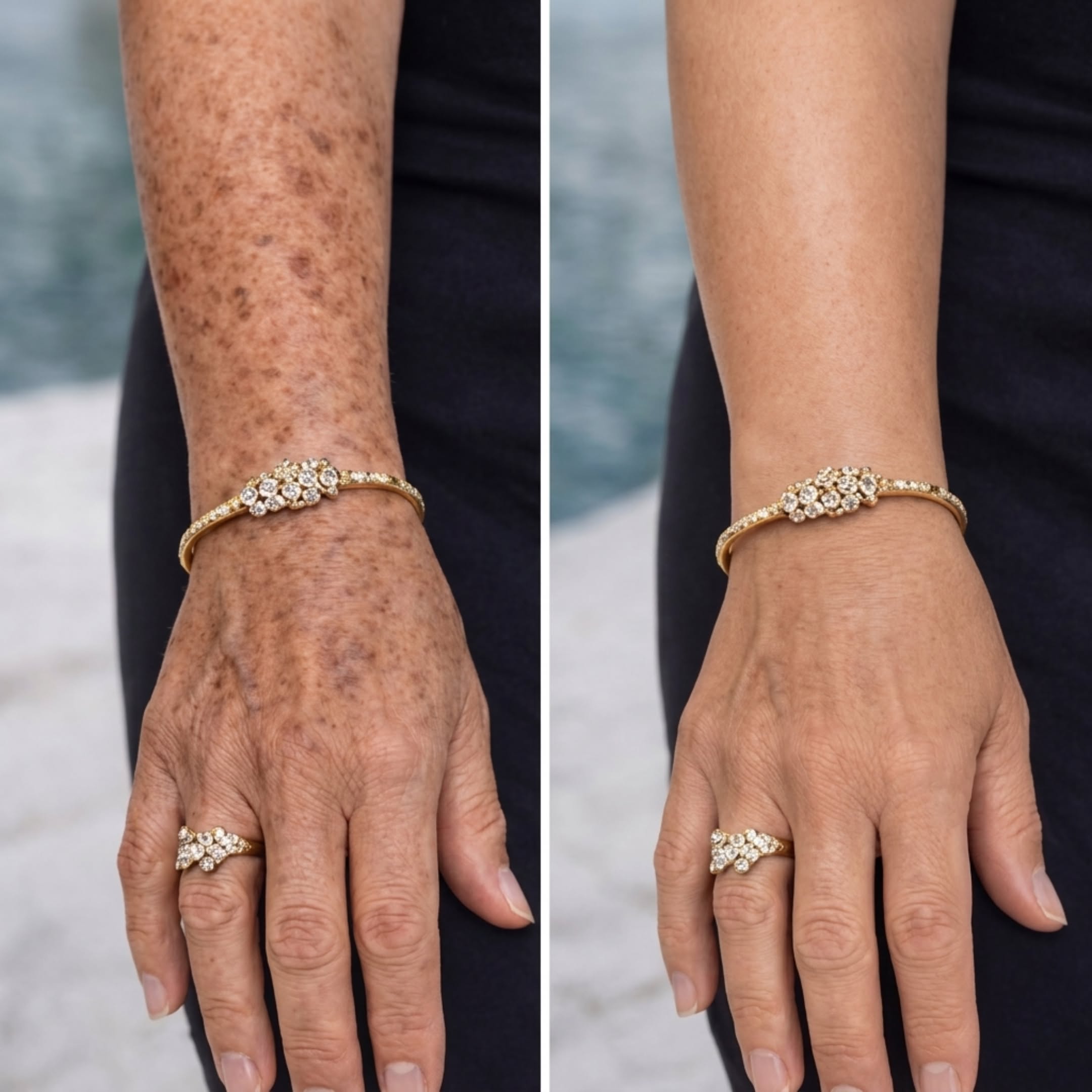
I'm a licensed esthetician. Yesterday, I ran my fingertips across a patient's hands and felt something I've never felt in eleven years of practice. I do this at the start of every session. Before I turn on the lamp, before I look at anything — I close my eyes and read the skin with my fingertips. Eleven years of treating hyperpigmentation teaches your hands to feel what your eyes haven't found yet. The raised edges of an active spot. The roughness where fresh pigment has saturated the upper layers. The slight resistance where the stratum corneum is thickened over a dark patch — the texture that tells me the deep dermis has been firing hard and the surface is carrying the load. I know this patient's hands by touch. I've been reading them for 16 months. But yesterday, something was different. The edges were soft. The texture over the darkest patches — the ones that had felt like faint ridges under my fingertips for over a year — was smooth. Level with the surrounding skin. The resistance was gone. I opened my eyes and looked under the lamp. The spots were measurably lighter. The edges diffused. The darkest patches visibly changed. I looked up. "What did you do before you came in today?" She looked slightly nervous. Like she'd done something wrong. "Oh — I've been using this Age Spot Cream on my hands and forearms every morning and evening. About three weeks now. Is that bad?" Let me back up. I practice clinical esthetics. I specialize in hyperpigmentation — age spots, sun damage, solar lentigines. It's a field that sits at the edge of dermatology and skincare, and most of my clients find me after they've tried everything else — prescription creams, laser series, IPL, chemical peels, hydroquinone — and nothing has permanently resolved their pigmentation. My treatment room is often the last stop before the dermatologist gives up and says "this is just what your skin does now." My clients are the deeply chronic ones. The ones with 20+ spots spreading across their hands and forearms. The ones whose dermatologists have said "you'll need ongoing maintenance forever." The ones who've spent $4,000, $6,000, $8,000 on treatments and watched the spots come back six weeks after every session. I see about 25 clients a week. About 70% come for hyperpigmentation. Sessions are $145 each. Most come every six weeks. The work is precise but humbling. I can read the skin and know immediately where the signal is locked in. When a client is in an active pigmentation state — when the deep dermis signal is firing hard — the spots have a certain quality. Defined edges. Dark centers. Texture that tells me the upper layers are saturated with fresh pigment pushed from below. When my treatments work, the edges soften. The centers lighten. The skin begins to breathe differently under my lamp. Janet has been seeing me every six weeks for 16 months. Chronic sun damage — hands, forearms, décolleté. She tried everything before finding me: three dermatologists, prescription tretinoin, hydroquinone at 4%, a full IPL series, two rounds of chemical peels at a medical spa. When she first sat in my chair, I examined her hands and the pigmentation was aggressive. Dense spots across both dorsums. Spots spreading to her forearms. The edges of every spot were sharp and hard — the way spots look when the deep dermis signal has been firing unchecked for years without anything reaching it. Over 16 months, I made progress. Treatment by treatment, the pigmentation faded incrementally. Her spot count went from covering roughly 40% of both hand dorsums to about 25%. The darkest spots lightened by two to three shades. She started feeling better about wearing short sleeves. But every six weeks, I started from the same place. The fresh pigment had returned. The edges had hardened again. The deep dermis signal had spent six weeks pushing new pigment upward unchecked. The skin had reset to its baseline between my appointments. I could treat it. She'd see improvement for three to four weeks. Then the freshness would return. The signal kept firing between sessions because everything I was applying — every exfoliant, every brightener, every carefully chosen active — was water-based. And water-based compounds stop at the stratum corneum. They cannot cross the lipid barrier. They cannot reach the deep dermis where the pigment signal lives. My treatments couldn't outrun the signal. Until yesterday. When I examined Janet's hands under my magnifying lamp and saw the spots already softer — already lighter, already less defined at the edges — I knew something had changed. Something external was reaching the signal between my sessions. Something was doing in the interval what I could only do on the treatment table. That's when she told me about the Age Spot Cream. Her daughter had found it online. A dermatologist-developed cream made specifically for Age Spots. It uses a combination of tranexamic acid and niacinamide to visibly fade age spots and improve uneven skin tone. These ingredients work so well because they are melanin inhibitors blocking the signal from the pigment so your skin stops producing new dark spots. No water. No fillers. No harsh chemicals. Just clinically proven ingredients that actually work. Not overnight. Over weeks of daily use. Janet applied it directly to her hands, forearms, and décolleté. Morning and evening. She'd been using it for about three weeks. I asked her to show me exactly where she applies it. She traced the path: across both hands. Up both forearms. Across the décolleté. That path is my treatment map. Those are the exact areas I assess and treat in every single session. The hand dorsums. The forearms. The décolleté. The areas where sun damage accumulates over decades and where the deep dermis signal is most persistently locked. She was applying the Age Spot Cream directly to the tissue I spend 60 minutes manually treating. And she was doing it twice a day, every day. I asked to see the bottle. White tube, forest green lettering. Clinical. Simpler than I expected. I read the mechanism description. Tranexamic acid — not a brightener that just sits on top, but a true melanin inhibitor that interrupts pigment at the source, where the signal actually fires. Niacinamide works alongside it to stop the pigment before it ever reaches the surface. They don’t just mask the dark spots. But they block the pigment, so existing spots fade and new ones stop forming. In esthetics terms: the formula was reaching the very layer that my water-based treatments were stopping short of. The deep dermis. The actual location of the pigment signal. The signal fires. Fresh pigment rises to the surface. I treat the surface pigment. The signal fires again. Fresh pigment rises again. But if something reaches the signal between sessions — if proven melanin inhibitors penetrate to the deep dermis twice daily — the signal doesn't fire as aggressively. And when Janet sits in my chair, I'm not starting from zero. That's exactly what I saw yesterday. Janet's pigmentation was already 70% improved before I began her session. My treatment took her from 70% to 95% instead of from 20% to 60%. The quality of the session was unlike anything I'd experienced with her in 16 months. I could see deeper changes. I could address the faint residual spots that had always been impossible to reach when the fresh surface pigment was obscuring them. I found lightening in areas that had been completely resistant before — like finally seeing through a window that had always been fogged. When the session ended, she said: "This is the best my skin has looked since I was 45. I feel like you finally got to something underneath." I know why. Because for the first time, we weren't spending the entire session just clearing the fresh surface pigment. The cream had already been doing that work twice a day for three weeks. I could address the deeper residual pigmentation that had been hiding underneath for 16 months. I went home and ordered the Age Spot Cream for myself. I have sun damage on my own forearms — comes with spending summers outdoors for twenty years. I applied it morning and evening for two weeks. The change was visible. Not overnight — gradual, the way real pigment correction always works. But spots I'd been watching stabilize for two years began to soften at the edges. Over the last three weeks, I've started recommending it to my hyperpigmentation clients. I frame it exactly as it is: "This reaches the signal between our sessions. It does the maintenance so my treatments can go deeper." The results are consistent. Clients whose pigmentation always reset between sessions are coming in with measurably softer spots. The fresh surface pigment that used to undo my work in six weeks is diminished. I can access the deeper residual pigmentation that was always hidden beneath the reset. One client told me: "Your treatments have gotten better." My treatments didn't get better. Her deep dermis arrived in a different state because the cream had been reaching the pigment signal for six weeks between our appointments. I don't sell products. I've never recommended a skincare product in eleven years of practice. My treatment philosophy is that the skin corrects itself when you give it the right conditions. This cream creates the conditions. It reaches the signal that drives the pigment cycling that keeps my clients stuck. It does between sessions what I can only do on the table. And it lets my treatments achieve results I've never been able to achieve before. Lavouria Age Spot Cream. Clinically proven melanin inhibitors that work — not overnight, but over weeks of consistent use. Applied directly to the hands, forearms, and décolleté — morning and evening. Penetrates all 7 skin layers to reach the deep dermis pigment signal. Developed by dermatologists who study the pigment signals that form age spots. 45,000+ customers. 4.8 star rating. 60-day money-back guarantee. $39.95. I spent 11 years learning to treat what this cream does between sessions. I'm not threatened by it. I'm grateful for it. Because it lets me do work I've never been able to do before. 👉
Performance Signals
- Status
- Still running
- Time Running
- 5 days
- Active Period
- Oct 27, 2026 → Today
- Advertiser live ads
- 392
- First Seen
- Oct 28, 2026
Creative & Links
- Meta page ID
- 1219946377859321
- Format
- Image
- Placements
- FACEBOOK, INSTAGRAM, AUDIENCE NETWORK, WHATSAPP, THREADS
- Country
- 🇮🇪 Ireland
- Landing Page
- lavouria.com/products/age-cream
- Original Ad
- Open in Meta Ad Library
More from Lavouria
See every ad this brand runs, with run dates, countries and the AI hook and angle of each.
Start 7-day free trialLavouria
lavouria.comLavouria
Shop Infos
- Created
- Aug 16, 2024 · 2y 3m
- Category
- Beauty & Fitness › Finance
- Live ads
- 392
- Peak ads (7d)
- 392
Search every indexed Meta ad by niche, format, country and run time, save creatives to boards and track the brands behind them. 7-day free trial.