Ekon Travel ad: I recovered in 8 weeks at 27. At 71, I'm still on a cane.

Ekon Travel
493 active ads🇺🇸
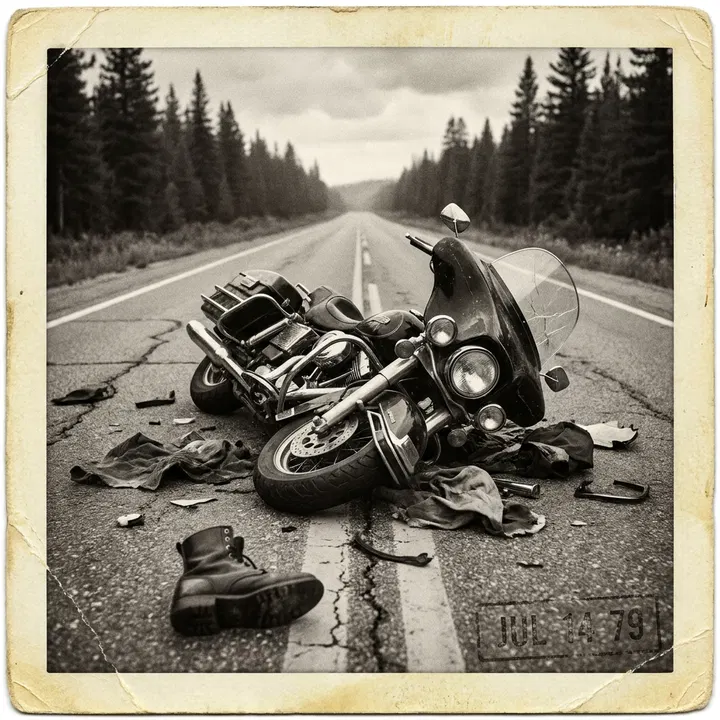
I was lying on my left side at the edge of Highway 90, two and a half miles from my own driveway, looking at a piece of bone standing straight up out of what used to be my jeans. For about four seconds I thought it was a stick that had gone through the denim. Then I understood it was my own shinbone, and that the jeans — $26 Wranglers from the Walmart in Saraland — were already gone, ground to powder somewhere back along eighty feet of asphalt. I was 71 years old. Two years later I am still on a cane. The thing is, I'd done this before. I went down on a motorcycle at 27, in almost the same kind of jeans, and I was back on the bike in eight weeks. So for forty-five years I believed I knew something about crashing that I did not know. A trauma surgeon in Mobile finally told me the truth last fall, and I have not been able to get it out of my head since. My name is Roy Donovan. I'm 73. I live in Saraland, twelve miles north of Mobile, Alabama. I spent 36 years as an electrician for Alabama Power. I'm writing this at four in the morning because I don't sleep more than a few hours anymore, and because my wife Helen told me if I didn't put it down somewhere it was going to eat me alive. If you're over 50 and you ride a cruiser in a hot state, in jeans, because everything else is either an oven or a costume — read this all the way down. There's one sentence in here I'd have paid a hundred thousand dollars to hear in 2008. You can have it for free. It's the line the surgeon said to me, and it's the whole reason I lived the second time and not just the first: The body only forgives you once. THE CRASH THAT TAUGHT ME THE WRONG LESSON. I'll be quick about the first one, because for 45 years I told it wrong. July 1979. I was 27, three years out of my apprenticeship. I hit a slick of motor oil on a curve outside Theodore on a Sportster, dislocated a shoulder, broke a wrist, and lost some skin off my right leg in a pair of Wrangler 13MWZs. One night in the hospital. Six weeks in a sling. Eight weeks until I was riding again. I told myself I'd dodged a bullet. I told myself it proved I was tough, that I was careful, that a man who knew what he was doing didn't really get hurt. Every word of that was wrong, and I rode on it for 45 years. The truth was simpler and I couldn't see it: a 27-year-old body had cashed in a piece of luck, and I'd written it down in my head as skill. I had no idea the bill on that luck was still open, drawing interest, and that it would come due on an ordinary Friday afternoon two and a half miles from my own driveway. 18 YEARS OF THE WRONG PANTS. When I retired in 2008 and bought a Road King, Helen looked at me across the kitchen and said, "Roy. You're 56. This time, please, buy real pants. I can't sit through another emergency room phone call." I told her I would. I meant it. And then I spent eighteen years doing exactly what the gear industry counts on every man my age to do. I bought the leather first. A cycle shop in Daphne, full-grain steerhide, armor in the knees, $529. "This is what serious riders wear," the kid told me. Three weeks later I took it on a 32-mile loop to Dauphin Island in 94-degree August Gulf humidity and nearly fell off the bike at a stop sign with tunnel vision. I sat on a curb at a Shell in Bayou La Batre for almost an hour while a stranger asked if he should call my wife. Leather is built to slide down a racetrack at 130 for thirty seconds. It is supposed to be hot. On a Road King going to a fish fry in 94 degrees, "hot" is its own kind of dangerous. Then the adventure textile. British brand, zippered vents, $339. A little cooler. But built for a man crossing Mongolia with two panniers of camping gear — enormous, stiff, and the vents that moved air at 65 did nothing at all sitting at a red light in July. The armor migrated two inches down my shins on every ride over half an hour. Then the Kevlar jeans. $249. Looked exactly like my Wranglers. The armor was thin foam wafers in fabric pockets that bunched and slid, and the so-called aramid panels were a patch about 8 inches by 5 sewn roughly over the knee. In 1979 I'd lost skin in plain Wranglers. What I'd just paid for was plain Wranglers with a small Kevlar sticker on the leg. That was $1,117 of pants hanging in my closet, and not one of them I could stand to wear through an Alabama summer. So I did what every rider my age eventually does. I gave up and rode in $26 Wranglers from the Walmart in Saraland. Only short trips, I told myself. Only on back roads. Only when it was hot — which on the Gulf Coast is most of the year. I rode in those jeans for eight years. THE CRASH THAT TOLD ME THE TRUTH. Friday, April 19th, 2024. I was 71, on the same Road King, coming back from a Lowe's run for a piece of PEX pipe Helen needed under the sink. Two and a half miles from home. Wranglers, denim work shirt, half-helmet, 76 degrees, the middle of a nothing afternoon. A Ford F-250 pulled out of a feed-store lot without ever turning his head. I had less than a second. I grabbed too much front brake, the bike washed out, and I hit the asphalt at 47 and slid eighty feet on my right hip and my left leg. I told you at the top of this letter what I saw when I stopped sliding. I won't make you read it twice. I'll only say that I was missing skin from my hip to the inside of my opposite knee, that my right arm wouldn't answer me, and that I was certain, lying there, that I was about to die on a road I'd driven ten thousand times. I didn't, because of the next thing that happened. A man stopped. Seventy-eight, maybe seventy-nine. Thin, white-haired, faded blue work shirt, a brown Buick LeSabre with Mississippi plates, headed home to Pascagoula. He pulled the car across the lane to shield me from traffic and put his hazards on before he ever opened the door. He knelt down slow, the way old men kneel, and said: "Son. I was a Navy corpsman. Two tours. I'm going to put a tourniquet on your leg and I'm going to stay right here until they come, and you are not dying on this road today. Look at my face." He pulled the belt out of his own pants — brown, tooled, the buckle worn smooth — and cinched it above the break in one motion. I screamed. He said, "Good. That means you can still feel it." Then he sat down on the hot asphalt next to me in his good khakis and put his hand flat on the middle of my chest and left it there for seventeen minutes. He talked the whole time, and never once about my leg. About his wife Eleanor, who'd passed in 2019. A granddaughter at Mississippi State. And a nineteen-year-old from Akron he'd lost in a field hospital outside Da Nang in 1968, who'd asked him to write a letter to his mother and died before they could finish it. He said he'd been carrying that unfinished letter in his head for fifty-six years, and that today, on this road, he was going to make sure another mother didn't get the visit. He said it twice, quiet, almost to himself. Not today. Not on my watch. When the ambulance came he stood up, picked his belt up off the road, and walked back to the Buick. The medics asked his name. All he said was, "I owe somebody this." Then he drove off toward Mississippi. I have spent two years trying to find him and I can't. I'll come back to that at the very end, because I need something from you on it. They told Helen at the hospital that my hip was fractured, my left shin was an open break, my collarbone was broken in two places, four ribs were cracked, and I'd lost enough skin that they brought the burn team in to look at me. Surgery the first night. On day nine the leg went septic, my fever hit 104, and they took me back to the operating room at half past eleven at night. The surgeon told Helen the next morning that it had been close — closer than she wanted to say out loud in front of me. Fourteen days in the hospital. Four months in a wheelchair. Six months on crutches. Two years on a cane, and I'm still on it. I can't lift my left leg past about waist height. I have a four-year-old grandson, Bobby, who was two when I went down. He has spent half his life watching his grandfather get dressed sitting on the edge of the bed. He's never been on my shoulders. This past winter my son told me Bobby had asked his mother whether grandpa was always going to be broken. That is the price of the wrong lesson, learned at 27 and paid at 71. WHAT DR. SULLIVAN SAID. Last October, eighteen months out, I went in to see Dr. Margaret Sullivan — the trauma surgeon who'd put me back together — for a routine follow-up. She read the films, said everything was healing about as well as it was going to, and I asked her the question I'd been asking everybody: when can I really ride again. She didn't answer it. She set the films down and was quiet for a second, and then she said something I don't think was strictly her job to say. "Mr. Donovan, I'm going to step outside my lane for a minute. When you crashed at 27 and walked away in eight weeks, that wasn't toughness. That was a young body doing what young bodies do. It healed fast, and it told you a lie — that the body bounces. It does. Once. At 71 it doesn't knit like that, and the skin tears where it used to scrape. Same crash, completely different man underneath." I told her I'd figured that part out lying in the grass on Highway 90. "Then here's the part you maybe haven't," she said. "Those jeans didn't protect you in April. They came apart in the first ten feet. You are sitting here today in spite of what you had on, not because of it. And I'll be honest with you the way I'd want somebody to be honest with my own father — I'm not going to promise you'd come through another one. So I'd think hard about what's between you and the road next time." I asked her, almost mad about it, what she expected a man to wear, since I'd already burned through eleven hundred dollars of pants that either cooked me or fell apart. She said the thing that actually changed my mind. "The stuff in the shops isn't built for you. It's built for racers, for round-the-world tourers, and for kids who want to look a certain way at a coffee shop. Nobody's building for a 71-year-old on a cruiser on the Gulf Coast who needs real armor that stays put, a shell that doesn't surrender on the first slide, and air that moves when he's sitting still in July. But somebody, somewhere, probably is — they'll be small, and your dealer won't carry them, because the big brands aren't going to put something on the shelf that makes their leather look like what it is. Go home and find them yourself." I drove home in a state I hadn't been in since the crash. Not sad. Angry. Angry at eighteen years of cooking and bulk and stickers-on-denim, angry that nobody in any shop I'd ever walked into had told me what a surgeon told me in ten minutes. HOW I FOUND THEM. I spent three weeks reading everything I could — certification ratings, crash studies, the older-rider forums, which are honestly some of the saddest corners of the internet, full of men posting pictures of their road rash and asking each other whether it's time to sell the bike. I was after one product that did four things at once: armor that didn't slide, a shell that held up at real speed, ventilation that worked at a standstill, and a cut that didn't make a 73-year-old look like he was cosplaying. Everything I found nailed three and blew the fourth. Then Wayne Coleman texted me. Wayne's 71, a chapter friend, ran tugboats on the Mobile River for thirty-nine years. He'd just come back from a rally in Panama City and gotten to talking in a Whataburger parking lot with a fella on a Street Glide wearing pants he'd never seen — looked like cargo pants, but with real armor sitting at the knee and hip. Wayne asked him about them. The man told him. Wayne's whole text was one line: "Roy — go look at these. Outfit called EKON. Finally somebody built 'em for guys like us." That last part is what got me off the couch. Not "the gold standard." Not "what serious riders wear." Built for guys like us. THE PART I'M LEAST PROUD OF. The pants are called RoadArmor. I ordered a pair in olive, size 38. And then I almost shipped them straight back without ever really testing them. Not because anything was wrong with them. Because everything feels fine in December. Leather feels fine at 65 degrees. Textile feels fine at 65. My old Wranglers felt fine at 65. I'd been fooled three times already, and after two weeks of mild rides I had the return label open on the computer on a Friday night with the cursor sitting on the print button. Helen came through on her way to the kitchen and stopped. "Roy. What are you doing." "Sending them back. They'll be like the rest." She looked at me for a long time. Then she said: "You've been lying to yourself since 1979. You lied about the first crash, you lied for eighteen years about the pants, and you spent two years in a wheelchair and a cane finding out the hard way. There is a little boy in Daphne who has never once been picked up by his grandfather. You will not send these back in December because you're too tired to wait for summer. Ride them in May. Then you can decide." I closed the computer. MAY. First real test was the first Saturday in April, then it got hot fast. 84 degrees, then 87. Coming home I caught a long red light at a big intersection and I was sweating the ordinary way, not the gray, tunnel-vision way. I reached down and pulled the vents open across my thighs. And I felt air move across my legs while the bike was sitting dead still at a red light. I had not felt that in eighteen years of riding on this coast. It is a small thing. If you've never spent a Gulf Coast summer baking inside the wrong pants, I know it doesn't sound like much. But sitting at that light it landed on me like proof — proof the surgeon was right, proof there had been a fourth option the whole time, proof a whole generation of us had been choosing between oven, costume, and sticker because nobody ever built the obvious thing. About a quarter mile down the road I realized I was crying inside the helmet. Hadn't done that in forty-nine years of riding. Not even in the back of the ambulance. That night I couldn't sleep. I went out to the garage with my cane at quarter to three and sat on the bike in the dark for an hour, and for the first time since the crash I understood that the answer to Bobby's question wasn't on a calendar of physical-therapy appointments anymore. It was hanging on a hook by the door. By the end of May I'd ridden a 96-mile day to Fairhope and back without ending up wrecked and dehydrated for the rest of it — something I hadn't managed since before the crash. I rode 28 minutes through a hard spring storm with the vents zipped and came home dry. I put more miles on in that one month than in any month since 2010. And the armor has not slid down my shin one single time, which after eighteen years of pads crawling toward my ankles I still can't quite believe. MY CHAPTER. The Mobile HOG chapter is about thirty-five of us, average age right around sixty. Before my crash, most were riding to Whataburger in jeans. After they watched me come back from the dead on a cane, that started to change. Wayne Coleman, 71, the tugboat captain who found them — already had a pair before I did. His text the day mine landed: "About time you listened to me." Charlie Boudreaux, 66, retired Mobile County deputy, leather man since 1988, swore up and down he'd never wear "Power Ranger pants." His cardiologist put him on a second blood-pressure pill and told him the heat was now a real problem, and he ordered a pair the next week. He rode out to the Tensaw twice last summer, trips he'd told himself he was finished with. He called me after the first one and said, "Why did nobody tell us about these ten years ago?" Big Sam Pettway, 69, runs a transmission shop in Theodore. One sentence when his came: "Threw my Wranglers in the shop-rag bin. Felt good." And my own brother Carl, 75, down in Pensacola on a Road Glide, wore Wranglers for the same reason the rest of us did. I sent him a pair at Christmas. He didn't want them. Helen made me ship them anyway. He wears them every ride now and will not give me the satisfaction of saying I was right. LET ME SAY THE QUIET PART. For eighteen years the thing that kept me out of real gear wasn't money. It was that every pair I'd ever seen looked like a costume — like I'd have to turn into somebody else, some safety guy, some gear snob, to put them on. And I wasn't going to ride to the Whataburger dressed like a stunt double. That was the mistake that nearly killed me, and it was based on nothing. These don't look like anything. They look like cargo pants. They're a regular pair of pants with real protection built into them — that's the whole product. There's no costume and no new identity. If I'd known at 56 that such a plain, simple thing existed, I'd have bought it at 56, and so would half my chapter. We didn't know, because nobody in the business we'd been handing our money to for decades ever said a word. Nobody paid me to write any of this. I don't work for EKON and nobody sent me a free pair. I paid for my first pair myself, bought a second a month later, and bought Carl's. I'm just a retired electrician trying to hand the next man the sentence I didn't get in time. THE SIMPLE PART. The pants are RoadArmor. The company is EKON. They sell direct — your local shop won't have them, because the dealer channel stocks what the big brands push. It's $149 for a pair, $249 for two, a belt comes with it, and there's a 60-day window to send them back. I ordered, almost returned mine, and now own three pairs. The link: https://ekontravel.com/products/roadarmor-pants Buy a pair. Wait for a 90-degree day. Get caught at a long light, reach down, open the vents, and feel the thing I felt at that intersection in May. If it doesn't do for you what it did for me, send them back inside sixty days. That's the entire arrangement. Something is going to step into your lane. Maybe not this year. Maybe ten years from now, on a road you've ridden a thousand times, on a morning that starts like every other one — a deer, a pickup, a wet leaf, a kid on a bike, a tire that lets go. You'll get about one second, and one second is not enough to do anything except find out what you're wearing. At 27, what I was wearing didn't matter much, because the body forgave me. At 71 it was the only thing that mattered, because the body was done forgiving. The body forgives you once. I used mine up in 1979 and didn't know it for forty-five years. You still have a choice about the rest. Make it before something else makes it for you. — Roy Donovan Saraland, Alabama May 2026 P.S. Three pairs of expensive pants are still hanging in my closet — the leather, the adventure textile, the Kevlar jeans. Helen won't throw them out. "Roy. You paid eleven hundred dollars for those. They're staying as a reminder." She's right. I look at them every time I open that closet. P.P.S. My son David — forty-six now, the man who pushed his father's wheelchair through a hospital lot for half of 2024 — called this winter and asked if I'd teach him to ride. We're picking out a Sportster in July. The first thing we're buying, before the bike, before the helmet, is a pair of these pants. If you've got a father, a brother, a husband, or a buddy over 55 who still rides in jeans because "everything else is worse" — send him this. Not for EKON. Not for me. For him, and for whoever in his life is waiting to be picked up off the floor. P.P.P.S. And this is the real reason I finally finished writing this. If you are the old Navy corpsman who stopped on Highway 90 outside Theodore on the afternoon of April 19th, 2024 — brown Buick LeSabre, Mississippi plates, a tooled western belt, and your hand on a stranger's chest for seventeen minutes telling him he was not going to die on that road — I am the man you knelt next to. I lived. My grandson finally got picked up this spring; he weighs thirty-eight pounds and we both cried. I have called every VFW and Legion post on the coast trying to find you. If anybody reading this knows a Vietnam corpsman from down around Bay St. Louis or Pascagoula who drives an old LeSabre and doesn't talk about it, tell him a man in Saraland owes him a handshake and would like to give it to him while there's still time. Please.
Performance Signals
- Status
- Still running
- Time Running
- 75 days
- Active Period
- Aug 18, 2026 → Today
- Advertiser live ads
- 493
- First Seen
- Nov 1, 2026
Creative & Links
- Meta page ID
- 256791957508230
- Format
- Image
- Placements
- FACEBOOK, INSTAGRAM, AUDIENCE NETWORK, MESSENGER, THREADS
- Country
- 🇺🇸 United States
- Landing Page
- ekontravel.com/products/roadarmor-pants
- Original Ad
- Open in Meta Ad Library
More from Ekon Travel
See every ad this brand runs, with run dates, countries and the AI hook and angle of each.
Start 7-day free trialEkon Travel
ekontravel.comEKON Travel makes motorcycle gear and accessories that look like everyday wear. Real protection for the road. 60 day risk free.
Shop Infos
- Created
- Jul 18, 2025 · 1y 4m
- Category
- Autos & Vehicles › Apparel
- Live ads
- 493
- Peak ads (7d)
- 493
- Copies of this ad
- 1
Search every indexed Meta ad by niche, format, country and run time, save creatives to boards and track the brands behind them. 7-day free trial.